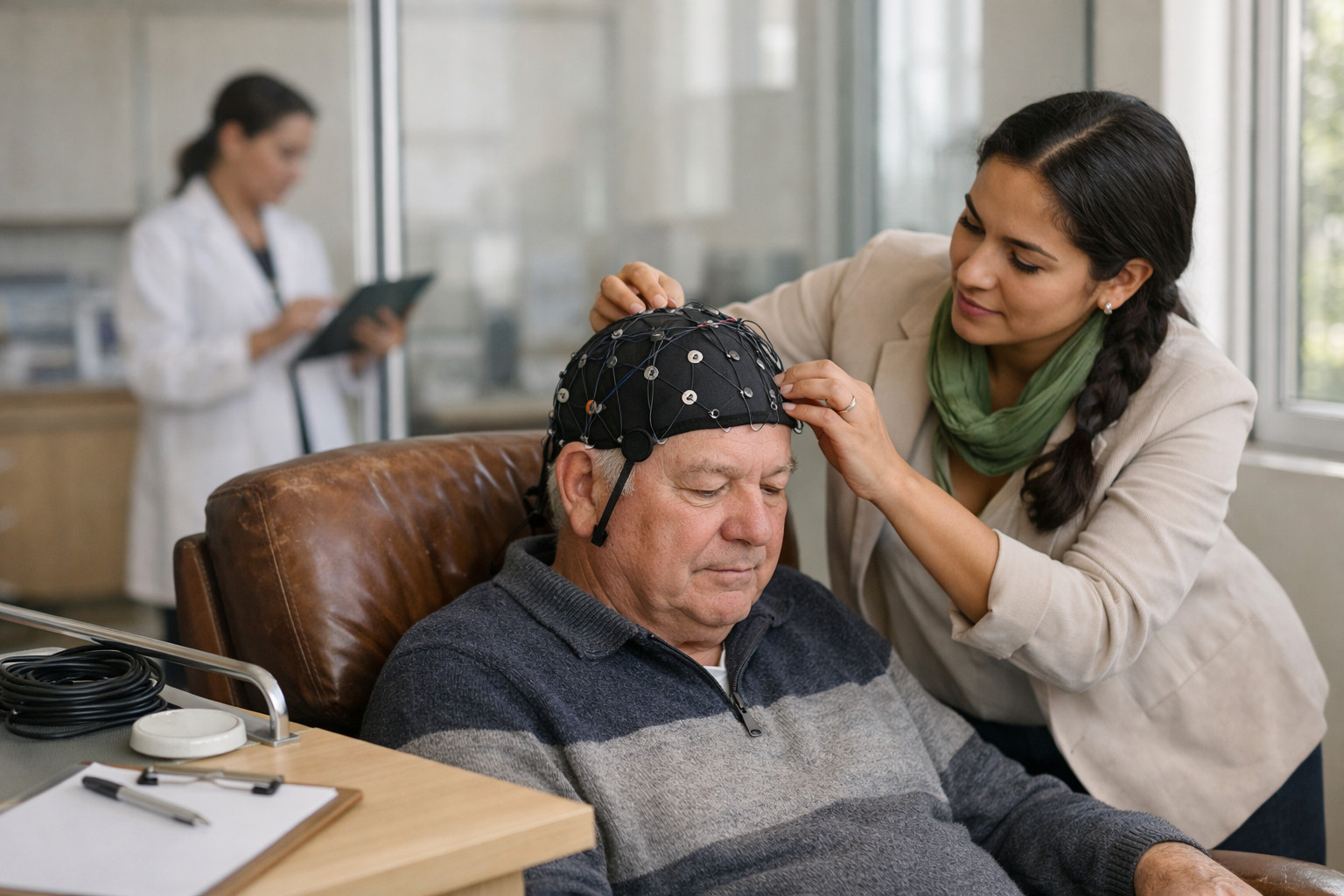
PTSD is one of the conditions where the gap between what treatment can offer and what patients actually receive is widest. Trauma-focused psychotherapy works, and it works well, but a substantial share of people either cannot access it, cannot tolerate it, or complete a full course and remain symptomatic. Medication helps some and does little for many. That gap is why non-invasive brain stimulation has drawn serious research attention over the past decade — and why the question of whether TMS helps PTSD comes up so often in our consultations, particularly from veterans and their families.
This article sets out where the evidence currently stands, what is cleared and what is not, how protocols differ from standard depression treatment, and what a realistic conversation with a provider should sound like.
The Regulatory Position, Stated Plainly
TMS is FDA-cleared for major depressive disorder, for obsessive-compulsive disorder, for anxious depression and for smoking cessation. It is not cleared for post-traumatic stress disorder. Any clinic that implies otherwise is misrepresenting the position.
What that means in practice is narrower than it sounds. Treating PTSD with TMS is off-label use, which is lawful and common across medicine, and it is frequently delivered to patients who carry a comorbid depression diagnosis that is itself an on-label indication. The overlap is not incidental: the majority of people with PTSD meet criteria for major depressive disorder at some point, and in that population the treatment is being delivered for a cleared indication in a patient who also has PTSD. That distinction matters enormously for insurance, and it is the single most useful thing for a patient to understand before making calls about coverage.
What the Research Shows
The PTSD literature on repetitive TMS is meaningful but less settled than the depression literature, and the honest summary has three parts.
The direction of effect is consistent. Multiple randomised sham-controlled trials and several meta-analyses report reductions in PTSD symptom severity with active stimulation relative to sham, with effect sizes that are moderate and clinically meaningful rather than marginal. Improvements have been observed across symptom clusters, including re-experiencing and hyperarousal, not only in the depressive symptoms that often accompany the disorder.
The protocols are heterogeneous. This is the main reason the field has not converged. Studies have targeted the right dorsolateral prefrontal cortex and the left, used high-frequency and low-frequency stimulation, and varied session counts substantially. Right-sided stimulation has a particular theoretical rationale in PTSD, given lateralised findings in threat processing and emotional regulation, and a number of positive trials have used it. But the comparative question — which target and which frequency is best — has not been answered definitively.
Combination approaches look promising. Some of the more interesting recent work pairs stimulation with trauma-focused psychotherapy, delivering TMS immediately before or during a therapy session on the theory that stimulation opens a window of enhanced plasticity in which extinction learning consolidates more effectively. Results have been encouraging, and the approach reflects something clinicians observe anyway: stimulation appears to work best as a way of making other treatment possible rather than as a standalone intervention.
What the evidence does not support is a claim that TMS resolves PTSD, or that it should displace trauma-focused therapy. It is best positioned as an option for people who have not responded adequately to first-line treatment, or who cannot engage with exposure-based therapy in their current state.
Why Veterans Ask About It Most
A disproportionate share of the interest in stimulation for PTSD comes from the veteran community, and the reasons are practical rather than ideological.
- Medication fatigue. Many veterans arrive having cycled through several SSRIs, an SNRI, prazosin for nightmares and something for sleep, with side effects that were as disruptive as the symptoms.
- Difficulty with exposure work. Trauma-focused therapies have strong evidence and meaningful dropout rates. Something that reduces baseline hyperarousal enough to make therapy tolerable has obvious value.
- Comorbid TBI. Blast exposure and PTSD frequently co-occur, and the interaction complicates treatment selection considerably.
- No sedation, no impairment. A treatment that does not blunt cognition or require a driver is easier to fit around work and family.
Comorbid traumatic brain injury deserves specific mention because it changes the safety calculus rather than simply adding a diagnosis. A history of significant TBI raises seizure threshold concerns and requires careful screening before stimulation, particularly where there is structural injury or a post-traumatic seizure history. It is not an automatic exclusion, but it is a conversation that should happen in detail rather than in passing.
How a Course Differs From Standard Depression Treatment
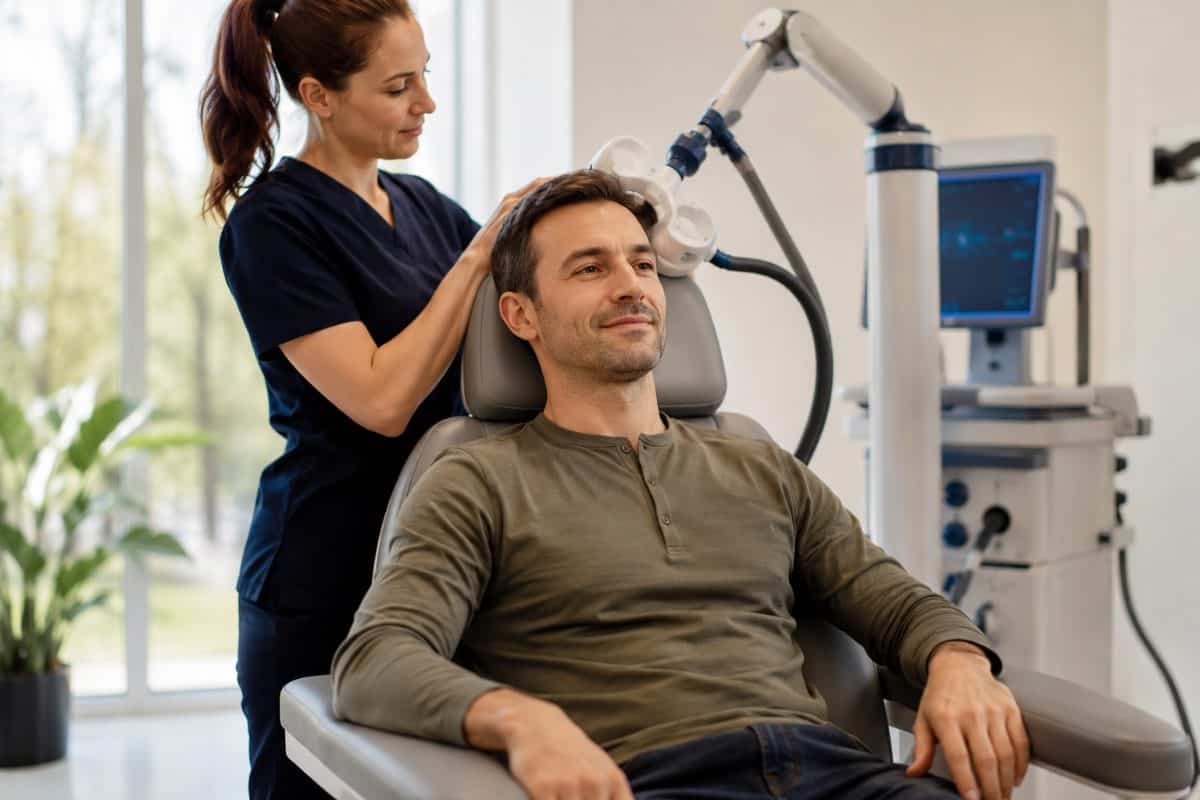
Mechanically the session is the same. Motor threshold is determined at a first mapping appointment, the coil is positioned over the prefrontal target, and subsequent sessions are short, awake and unrestricted. Our walkthrough of what happens at a first TMS session applies unchanged.
What differs is the surrounding plan. Where PTSD is the primary target, providers commonly consider right-sided stimulation, coordinate sessions with a trauma therapist rather than treating in isolation, and track PTSD-specific outcome measures alongside depression scales. Some practices use EEG-informed approaches to individualise parameters; we explain that methodology in our overview of qEEG brain mapping and how it is applied in MeRT versus TMS.
One clinical point is worth flagging honestly: stimulation in trauma can transiently increase arousal or intrusive symptoms in the early weeks for some patients. It is not universal and it is usually manageable, but it is a reason to have therapeutic support in place during a course rather than arranged afterwards.
Side Effects and Screening
The physical side effect profile does not change by indication: scalp discomfort at the treatment site during the first week, occasional headache, facial twitching while the pulse train runs, and a hearing protection requirement at every session. Seizure risk is very low and is managed by screening. Our detailed guide to TMS therapy side effects covers each of these.
Screening in a PTSD population warrants extra attention in three areas: history of traumatic brain injury and any post-traumatic seizures; current alcohol or sedative use, since withdrawal lowers seizure threshold; and medications such as bupropion or tramadol that do the same. Complete disclosure here is a safety requirement rather than a formality.
What Response Looks Like, and Over What Timeframe
Expectations set badly at the start are the most common reason a course gets abandoned halfway through, so it is worth being specific about what improvement tends to look like.
Change in PTSD is rarely announced by the disappearance of a symptom. What patients more often describe first is a change in reactivity: the startle response softens, the effort required to be in a crowded room drops, sleep consolidates for a few more hours. Intrusive memories may still occur but occupy less of the day and take less time to recover from. Partners and family members frequently notice the shift before the patient does, which is one reason involving someone close in the process is useful rather than intrusive.
The timeframe is measured in weeks, not sessions. A standard course runs five days a week for six weeks or so; meaningful change more commonly appears somewhere between weeks three and six, and continues to build for a period after the course ends. Judging a course at week one is judging it before anything has had time to happen. Keeping a brief daily record — a sleep note, a one-to-ten rating for arousal, a line on anything avoided that day — gives a provider something concrete to work from and protects against the recall bias that makes slow improvement feel like none.
How It Compares With Other Options You Will Encounter
Anyone researching PTSD treatment runs into a crowded field of neuromodulation and interventional options, not all of which sit on the same evidentiary footing.
- EMDR is a trauma-focused psychotherapy with substantial evidence in PTSD. It is a complement to stimulation, not a competitor; we compare the approaches in EMDR versus MeRT and TMS.
- Neurofeedback is a distinct modality that trains rather than stimulates. Its evidence base in PTSD is earlier-stage than that for rTMS; see neurofeedback versus MeRT and TMS.
- Accelerated protocols compress a course into days rather than weeks by delivering multiple sessions daily. Most of the accelerated evidence is in depression rather than PTSD, but the format solves a real access problem for people travelling for care. See accelerated TMS and its FDA clearance.
Coverage and Cost
Because PTSD is not a cleared indication, insurers do not authorise TMS for PTSD as such. In practice, coverage is obtained on the basis of a comorbid major depressive disorder diagnosis that meets the plan’s treatment-resistance criteria — typically documented failure of an adequate number of antidepressant trials at adequate dose and duration.
For veterans and military families the specific plan matters a great deal, and criteria differ between VA care, Tricare and commercial coverage. Our overview of Tricare and Blue Cross Blue Shield brain health coverage outlines the differences. As with any authorisation, a complete written medication history assembled from every prescriber you have seen is the single most effective way to shorten the process.
Frequently Asked Questions
Is TMS FDA-approved for PTSD?
No. TMS is cleared for major depressive disorder, OCD, anxious depression and smoking cessation. Use for PTSD is off-label, though many patients are treated for a comorbid depression diagnosis that is itself an on-label indication.
Does TMS work for PTSD?
Randomised sham-controlled trials and meta-analyses report moderate reductions in symptom severity with active stimulation. The evidence is meaningful but less mature than for depression, and optimal targeting and frequency have not been settled.
Can TMS replace trauma therapy?
No, and it is not intended to. The more promising research combines stimulation with trauma-focused psychotherapy rather than substituting for it. Having therapeutic support in place during a course is recommended.
Is TMS safe if I have a history of TBI?
It requires careful individual screening. Structural injury and any history of post-traumatic seizures raise the risk profile and must be disclosed and evaluated before treatment is considered.
Will the VA or Tricare pay for it?
Coverage decisions rest on a cleared indication, which in practice means a documented treatment-resistant depression diagnosis. Criteria vary by plan and are worth confirming directly rather than assuming.
Where This Leaves a Patient
TMS for PTSD sits in an honest middle position: supported by real randomised evidence, not yet cleared for the indication, and most convincing when it is used to make trauma-focused therapy possible rather than to replace it. For someone who has completed adequate medication trials, who has comorbid depression, and who has therapeutic support in place, it is a reasonable option to discuss. For someone who has not yet tried first-line treatment, it is premature.
The questions worth putting to any clinic are simple: how many PTSD patients have you treated, which target and protocol would you use and why, how will you coordinate with my therapist, and what indication will you be billing under. A clinic that answers all four clearly is worth talking to further.
This article is for general education and is not individual medical advice. Off-label treatment decisions should be made with a qualified clinician who has evaluated your full history. Veterans in crisis can reach the Veterans Crisis Line by dialing 988 and pressing 1.