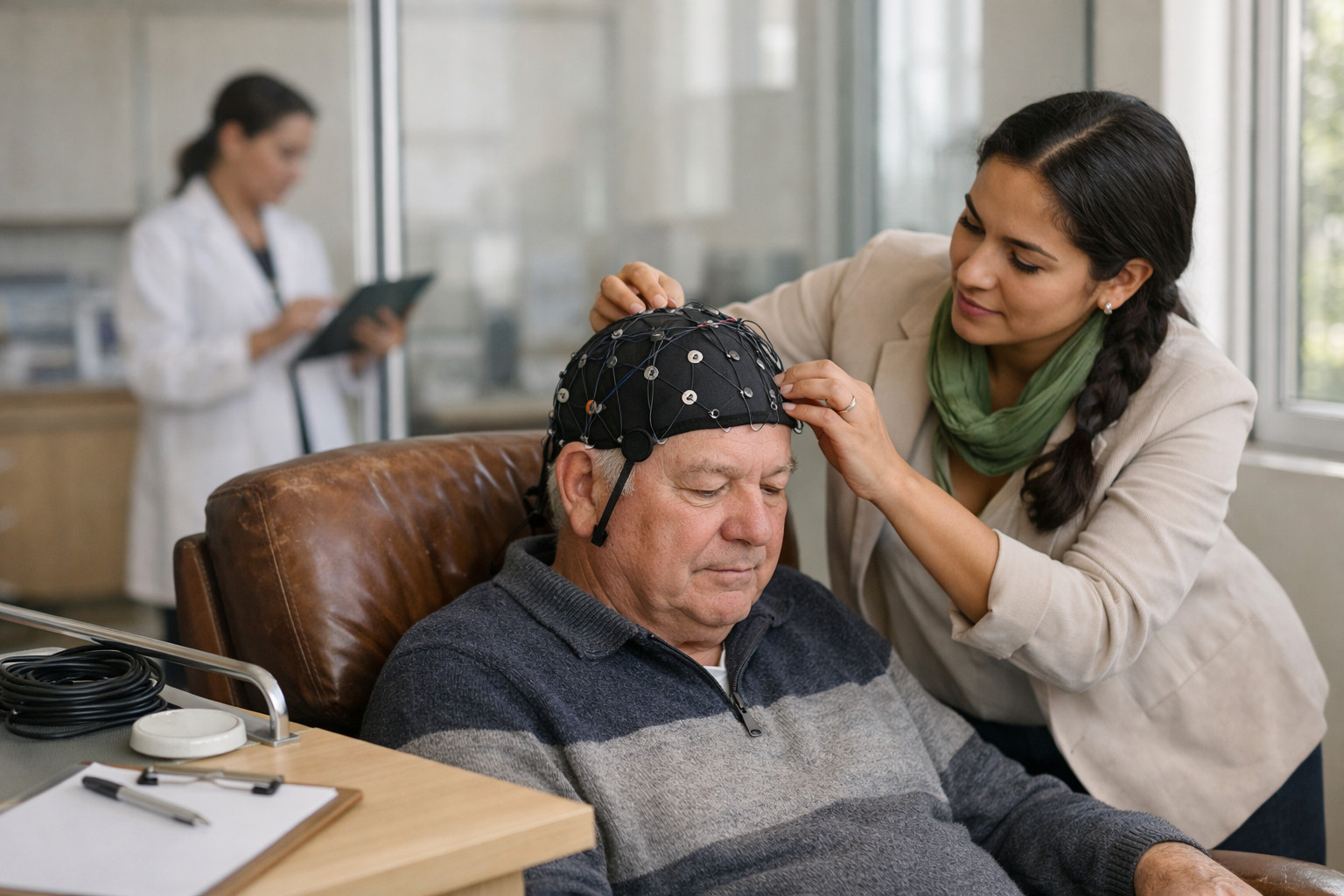
Every patient who sits down for a TMS consultation asks some version of the same question: what is this going to do to me? It is a fair question, and it deserves a fuller answer than “it is well tolerated.” TMS is well tolerated — that is one of the main reasons it exists as an option for people who could not stay on medication — but well tolerated is not the same as effect-free, and knowing what is normal makes the first two weeks considerably less unnerving.
This article covers what the side effect profile of transcranial magnetic stimulation actually looks like: what is common and self-limiting, what is rare and serious, what can be adjusted at the machine, and when something is worth reporting rather than waiting out.
Why TMS Has a Different Side Effect Profile Than Medication
The distinction that matters most is that TMS is a focal, non-systemic treatment. An antidepressant taken by mouth is absorbed, distributed throughout the body, and acts on receptors in the gut, the vasculature and the reproductive system as readily as it acts in the brain. That is where the familiar burdens of pharmacotherapy come from: weight change, sexual dysfunction, sedation, gastrointestinal upset, emotional blunting.
A magnetic pulse delivered through a coil positioned against the scalp does not circulate. Its effects are concentrated in a region of cortex a few centimetres across and the networks connected to it. As a direct consequence, the side effects associated with TMS are overwhelmingly local — they occur where the coil sits, or in the tissue the pulse passes through on its way in. Systemic complaints are conspicuously absent from the profile, which is precisely why TMS is often considered for patients who could not tolerate two or three medication trials. We compare the broader risk and benefit picture in our overview of TMS efficacy against traditional treatments.
Common Side Effects, and What They Actually Feel Like
Scalp discomfort at the treatment site
This is the most frequently reported effect, and the great majority of patients experience some version of it during the first week. Descriptions vary: a tapping that becomes sharp, a pinching sensation, a feeling that a rubber band is being flicked against the same spot repeatedly. It is not caused by the magnetic field acting on the brain — the brain has no pain receptors — but by stimulation of nerve endings and small muscles in the scalp that the field passes through.
Two things reliably happen. First, it fades. Most patients report that by sessions four to six the same intensity feels markedly less sharp, an accommodation effect that is consistent enough to be worth telling patients about in advance. Second, it is adjustable. Small changes in coil angle, a slightly slower ramp to full intensity over the first several sessions, or repositioning by a few millimetres will often resolve it. If it is not improving, that is a conversation to have with the technician rather than something to endure quietly.
Headache
Headache after a session is the second most common complaint, typically mild to moderate, typically frontal or at the treatment site, and typically resolving within a few hours. It responds to ordinary over-the-counter analgesics, and taking one before a session is a reasonable strategy in the first week if headaches are predictable. Like scalp discomfort, incidence drops substantially after the first several sessions.
Facial twitching during stimulation
Contraction of the jaw muscle, the muscles around the eye, or occasionally the eyebrow on the treated side is common and expected. The coil sits near the temporalis muscle, and each pulse recruits it. It stops the instant the train of pulses stops. It is disconcerting the first time and unremarkable by the third.
Lightheadedness and neck discomfort
A brief sensation of lightheadedness on standing after a session is occasionally reported and usually reflects having sat still in one position for twenty minutes rather than anything neurological. Neck or shoulder stiffness comes from head positioning; adjusting the headrest usually solves it.
Hearing: The Effect Most Worth Taking Seriously
The TMS coil produces a loud, sharp click with each pulse, and that acoustic output is genuinely capable of causing temporary threshold shifts in hearing if the ear is unprotected. Transient tinnitus after a session has been reported in patients who did not wear hearing protection.
This is also the most completely preventable item on the list. Earplugs are provided and should be worn correctly at every session without exception, including short theta burst sessions. Wearing them loosely defeats the purpose. If you have pre-existing hearing loss or tinnitus, say so during your consultation — it does not preclude treatment, but it warrants attention.
Rare but Serious: Seizure Risk in Context
Seizure is the serious adverse event associated with TMS, and it is the one patients have usually read about before they arrive. The honest framing is that the risk is real, extremely low, and actively managed by the screening you go through before treatment starts.
Published estimates from large clinical series place the incidence on the order of one event per tens of thousands of sessions when standard safety parameters are followed. Reported events have been self-limiting, occurred during stimulation rather than afterwards, and have not been associated with a subsequent epilepsy diagnosis. Several factors raise the risk above baseline, which is why they are asked about in detail:
- A personal history of seizure or epilepsy, or a first-degree family history.
- Structural brain lesions, prior stroke, or significant traumatic brain injury.
- Medications that lower seizure threshold, including bupropion at higher doses, clozapine, tramadol and certain stimulants.
- Abrupt withdrawal from alcohol, benzodiazepines or other sedatives.
- Substantial sleep deprivation or acute illness on the day of treatment.
None of these are automatic disqualifiers. Several of them simply change how the protocol is parameterised or prompt a conversation with your prescriber about timing. What they do require is accurate disclosure, which is worth emphasising: an incomplete medication list is a safety issue, not a paperwork issue.
Manic Switch and Mood Effects
Any effective antidepressant treatment carries some potential to precipitate hypomania or mania in a patient with an underlying bipolar diathesis, and TMS is not exempt. The reported rate is low, and the presentation is usually recognisable early: a sharp drop in sleep need, accelerating speech, an unusual surge in goal-directed activity, spending or risk-taking that is out of character.
This is one of the clearest reasons to tell your provider about any personal or family history of bipolar disorder before starting, and to give the people around you permission to say something if they notice a change you do not. If you are unsure how the two presentations differ, our comparison of bipolar depression and unipolar depression symptoms covers the distinction.
What TMS Does Not Do
Some of the most useful information is negative, because it addresses fears that patients often carry without voicing them.
- No memory impairment. This is the clearest point of difference from electroconvulsive therapy, which does carry a cognitive burden. Cognitive testing across TMS trials has not shown deficits, and some measures improve as depression lifts. We set the two treatments side by side in TMS versus ECT.
- No sedation and no anaesthesia. You are awake and conversational throughout. There is no recovery period and no ride home required.
- No weight gain, sexual side effects or emotional blunting. These are systemic drug effects and do not follow from focal stimulation.
- No cumulative damage. A completed course does not leave a residue. Maintenance and repeat courses are routinely delivered.
When to Report Something Rather Than Wait
Most of what happens in the first two weeks resolves on its own. A short list deserves a same-day call rather than a mention at your next appointment:
- Headache that is severe, unlike your usual pattern, or not responding to over-the-counter medication.
- New or worsening ringing in the ears that persists after the session ends.
- Any loss of awareness, confusion, or an episode you cannot fully account for.
- A marked drop in sleep need together with racing thoughts or unusually elevated mood.
- New or intensifying thoughts of self-harm.
That last point is worth stating plainly. Depression treatment of any kind takes place while the illness is still present, and worsening suicidal thinking during a course is an urgent clinical matter regardless of what is causing it. If you are in crisis, call or text 988 in the United States.
Frequently Asked Questions
How long do TMS side effects last?
Scalp discomfort and headache are the two common effects, and both typically diminish substantially within the first one to two weeks as tissue accommodates to stimulation. They do not usually persist through a full course.
Can the intensity be lowered if it hurts?
Yes, and it often is during the first several sessions. Ramping gradually toward the full percentage of motor threshold is a standard comfort strategy. Coil angle adjustments are equally effective and do not compromise the dose.
Do accelerated protocols have more side effects?
The per-session profile is comparable, though multiple sessions in a single day concentrate the scalp exposure into a shorter window. Our article on accelerated TMS and its FDA clearance covers how these protocols differ in practice.
Are side effects different for MeRT?
MeRT uses the same underlying stimulation technology with individualised parameters derived from EEG, so the local side effect profile is broadly similar. We explain how the two approaches differ in MeRT versus TMS.
Will I need to stop my medication?
Usually not. TMS is generally delivered alongside existing treatment. Some medications are reviewed because they interact with seizure threshold or can blunt response, but changes are made by your prescriber, never on your own.
The Practical Takeaway
The side effect profile of TMS is narrow, local and front-loaded: it is worst in the first week, it is adjustable at the machine, and it does not carry the systemic burden that drives so many people off medication in the first place. The serious risks are rare and are managed by the screening you complete before your first appointment, which is a good reason to answer those questions completely. For a walkthrough of what the appointment itself involves, see your first TMS session, step by step.
This article is for general education and does not replace individual medical advice. Discuss your own history, medications and risk factors with a qualified provider before beginning treatment.