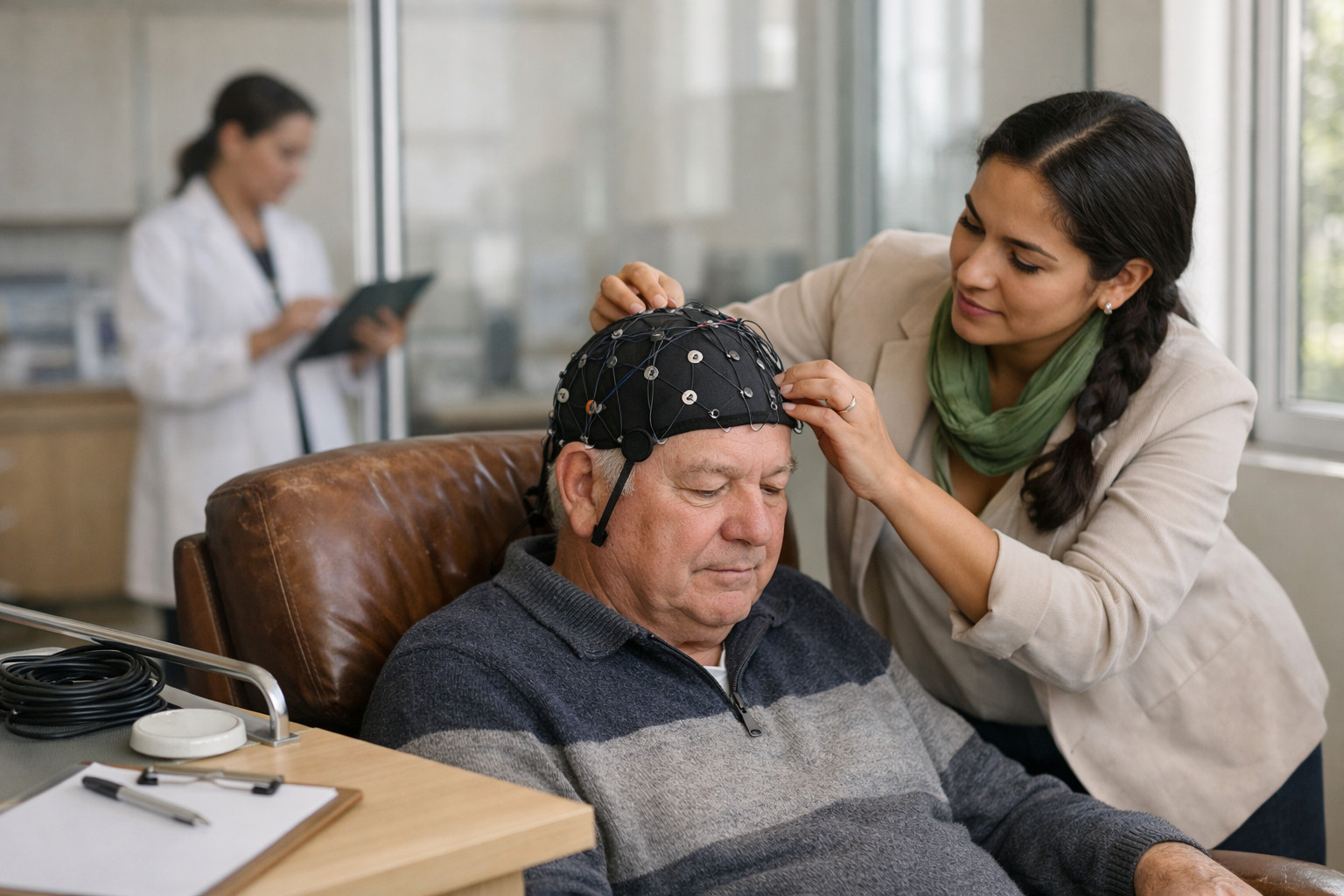
Parents in the autism community are often the first to notice new research and ask thoughtful questions about emerging treatment options. Recently, more families have been asking us about accelerated TMS for autism: multiple TMS sessions per day, theta burst stimulation, and whether children can safely complete treatment in a shorter period of time. Accelerated TMS means delivering more than one stimulation session per day so a course of treatment can be completed in days rather than weeks, and a recent, well-designed study has brought new attention to this approach for children on the autism spectrum.
At Brain Performance Technologies, we believe families deserve clear, honest, and research-informed answers. Here is what the new research actually found, what it does and does not mean, and how we think about accelerated schedules for children.
What Is Accelerated TMS?
TMS, or transcranial magnetic stimulation, is a non-invasive treatment that uses magnetic pulses to stimulate targeted areas of the brain. It does not involve surgery, anesthesia, or medication.
Traditional TMS is commonly done once per day over several weeks. Accelerated TMS uses more than one session per day, allowing treatment to be completed in a shorter time period. Some accelerated protocols use a brief form of stimulation called theta burst stimulation, or TBS, which may take only a few minutes per session.
In simple terms: traditional TMS usually means one session per day over multiple weeks, while accelerated TMS means multiple shorter sessions per day over fewer days. For families who travel to reach treatment, that difference matters enormously, which is one reason accelerated TMS is drawing so much interest.
The New Research: What the Study Showed
A recent study published in the BMJ has brought more attention to this topic. Researchers in China studied an accelerated form of TMS called accelerated continuous theta burst stimulation, or a-cTBS, in 200 children with autism spectrum disorder, ages 4 to 10. Half of the children received active stimulation and half received a sham, or placebo-like, treatment. The active group received 10 brief sessions per day for five consecutive days.
The results were encouraging. Children who received active treatment showed greater improvement in social communication than children who received sham treatment, measured by a caregiver questionnaire called the Social Responsiveness Scale, Second Edition (SRS-2). The improvement appeared shortly after the five-day treatment and was still present at the one-month follow-up. The study also reported gains in some language-related storytelling and comprehension measures.
Two honest caveats belong next to those findings. First, the study did not show a major improvement in restricted interests or repetitive behaviors, so the most accurate takeaway is that accelerated TMS may be more relevant to social communication and language-related function than to every feature of autism. Second, one study, however promising, is a foundation for further research, not a finished answer.
It is also worth noting something genuinely meaningful about this trial: it included young children and children with intellectual disability, groups that are too often left out of clinical research.
What About Side Effects?
In the study, side effects were generally mild to moderate and resolved without intervention. Restlessness and scalp discomfort were more common in the active treatment group. One child experienced a temporary arm spasm during treatment; stimulation was stopped, the symptom resolved within minutes, and it did not recur during follow-up.
The main practical concern with multiple sessions per day is that a child may become overstimulated. Possible side effects can include hyperactivity or restlessness, headache, scalp discomfort, fatigue, irritability, sleep changes, dizziness, or ringing in the ears. More sessions per day may be convenient, but the schedule must be adjusted if a child becomes too hyperactive, too tired, or uncomfortable after treatment. A safe plan is a flexible plan.
If your child is receiving multiple sessions per day, tell the clinical team promptly if you notice increased hyperactivity, irritability, unusual fatigue, headaches, poor sleep, emotional or behavioral changes, or any unusual physical symptoms. Reducing the number of daily sessions is always an available option.
Is BPT Offering Multiple Sessions Per Day?
Brain Performance Technologies may consider multiple TMS sessions per day for children with autism when clinically appropriate. Our approach is cautious and individualized, because we do not believe every child should automatically receive the most aggressive schedule.
A cautious accelerated schedule may begin with two sessions per day. For children who tolerate treatment well, a physician may consider increasing to three or four sessions per day. In select cases, up to eight sessions per day may be considered, but only with physician oversight, parent consent, and close monitoring. The study used 10 sessions per day, but that does not mean every child or every clinic should automatically follow the same schedule. At BPT, the number of daily sessions is based on physician guidance, parent feedback, and the child’s tolerance.
This is the same philosophy behind all of our care: individualized, data-guided, and honest about what the evidence supports. If you are earlier in your research, our parent’s guide to MeRT for autism walks through what a full course of treatment involves.
Is Accelerated TMS the Same as MeRT?
Families searching this topic often encounter several overlapping terms, so it helps to place them clearly. TMS is the broad technology category: non-invasive magnetic stimulation of the brain. Theta burst stimulation is a shorter form of TMS. Accelerated TMS describes the schedule, meaning multiple sessions per day. And MeRT, or Magnetic e-Resonance Therapy, is a personalized version of TMS that uses EEG information to guide where and how stimulation is delivered.
The important thing to remember is that MeRT is a version of TMS. These terms are related but not identical, so it is always fair to ask a clinic what protocol is being used, what brain area is being targeted, how many sessions are planned, and what safety monitoring is in place. Our comparison of MeRT vs TMS explains the distinction in more depth.
Is Accelerated TMS for Autism FDA-Cleared?
This is an important distinction, and families deserve a straight answer. TMS is FDA-cleared for certain conditions, including major depressive disorder, and accelerated TMS protocols recently received FDA clearance for depression in adults. However, accelerated TMS for autism remains an emerging clinical and research area, not an FDA-cleared indication.
Families should be cautious of any clinic claiming that accelerated TMS “cures autism” or is guaranteed to work. The responsible message is that accelerated TMS for autism is promising but still developing. It should be discussed carefully with a qualified physician and should come with clear expectations, safety monitoring, and an individualized treatment plan.
Final Thoughts for Parents
The new research on accelerated TMS for autism is exciting because it suggests that carefully delivered magnetic stimulation may help improve social communication in some children, and because it studied the young and often-overlooked children who most need good evidence. Still, this is not a one-size-fits-all treatment.
At Brain Performance Technologies, our position is that accelerated TMS and multiple sessions per day may be considered under physician oversight, with parent consent and close monitoring, and with a schedule individualized to each child’s tolerance, behavior, and family feedback. Our goal is to use emerging science responsibly, with hope, caution, and individualized care. If you would like to talk through whether an accelerated schedule makes sense for your child, reach out to our team for a consultation.
Frequently Asked Questions
What is accelerated TMS for autism?
Accelerated TMS means delivering more than one TMS session per day so a course of treatment can be completed in days rather than weeks. In autism research, accelerated protocols using brief theta burst stimulation have shown promising results for social communication, though this remains an emerging area.
What did the new study on accelerated TMS for children with autism find?
A BMJ-published study of 200 children ages 4 to 10 found that five days of accelerated theta burst stimulation improved social communication scores compared with sham treatment, with gains still present at one-month follow-up. It did not show major improvement in restricted or repetitive behaviors.
Is it safe for a child to have multiple TMS sessions in one day?
In the study, side effects were generally mild to moderate and resolved on their own, with restlessness and scalp discomfort most common. Safety depends on physician oversight, close monitoring, and a flexible schedule that is reduced if a child shows overstimulation, fatigue, or irritability.
Is accelerated TMS for autism FDA-cleared?
No. TMS is FDA-cleared for conditions such as depression in adults, and accelerated protocols were recently cleared for adult depression, but accelerated TMS for autism remains an emerging research area rather than a cleared indication.
Is MeRT the same as accelerated TMS?
MeRT is a personalized version of TMS that uses EEG data to guide treatment, while accelerated TMS refers to the schedule of multiple sessions per day. A treatment plan can be personalized, accelerated, both, or neither, which is why it is worth asking your clinic exactly what protocol is proposed.
How many sessions per day would my child receive?
At BPT, a cautious accelerated schedule may start with two sessions per day, increasing to three or four if well tolerated, and only in select cases up to eight, always with physician oversight, parent consent, and close monitoring. The right number is individual.
This article is for educational purposes and is not a substitute for personalized medical advice. Always consult a qualified healthcare provider about your specific situation.