What does MeRT Treatment Involve?

by | May 10, 2023 | MeRT

What Does MeRT Treatment Involve?


Now that the question “What is MeRT” has been answered, the next logical question is “What does MeRT involve”?  What happens once you have decided on treatment?

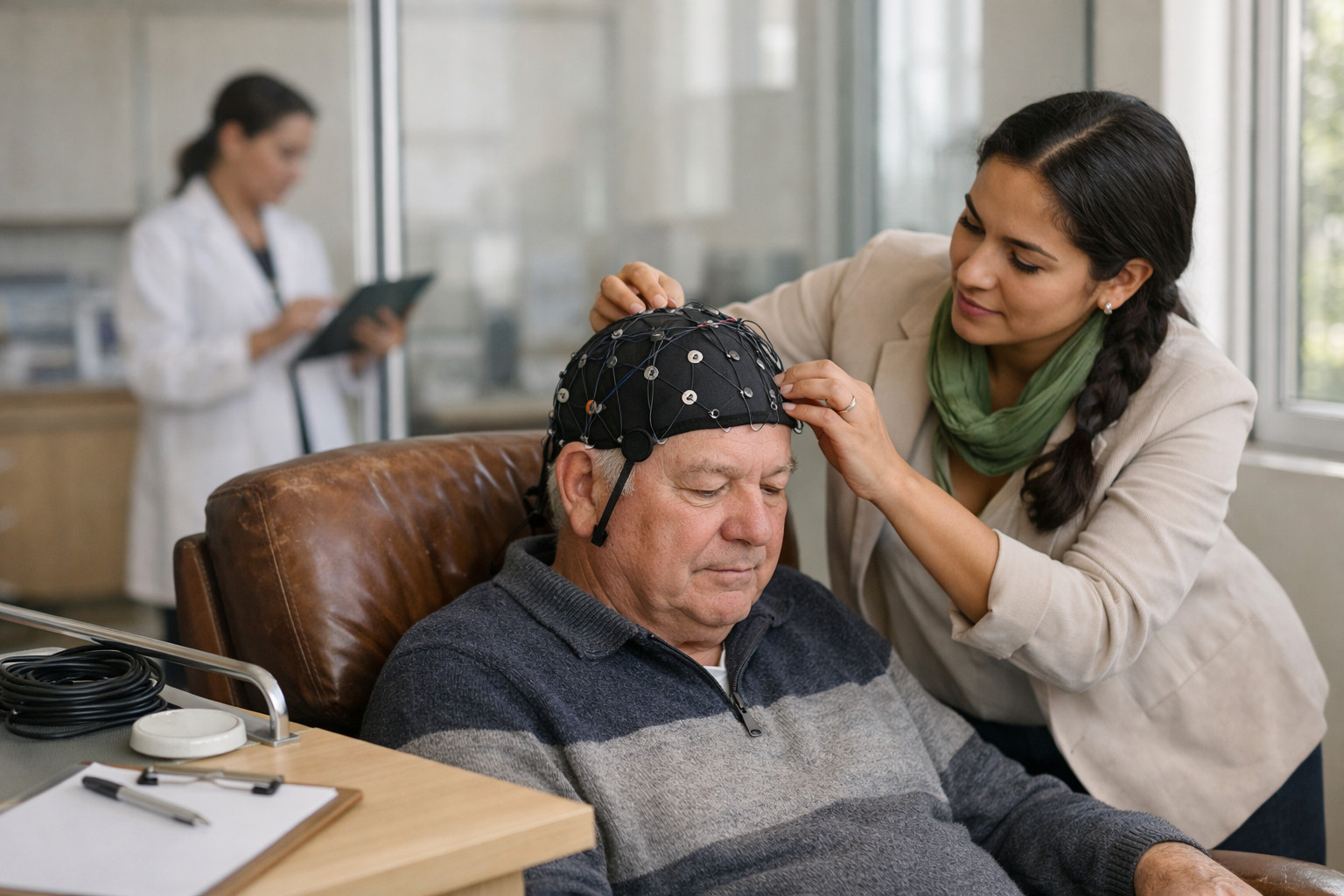
EEG and Consultation –  begins by applying a cap on the scalp, then adding gel to the electrodes of the cap. Generally, the patient keeps their eyes closed and remains relatively still for a period up to 10 minutes under the direction of the technician administering the test. EEGs are necessary as they allow for personalized treatment. A simple analogy: if you go into a shoe store to buy a pair of shoes, the store needs more information than “a pair of shoes”, or even a “pair of men’s shoes”. Size, width, occasion, etc. …all necessary to obtaining the right pair of shoes.

  1. Prior to the EEG, fill out intake forms and behavioral questionnaires
  2. The initial EEG takes anywhere from 15-45 minutes
  3. Consultation with Doctor regarding EEG results
  4. He will go over possible side effects and outcomes of our treatment
  5. Strategies for acclimating a patient to treatment are available and can be discussed during the consultation

Treatment
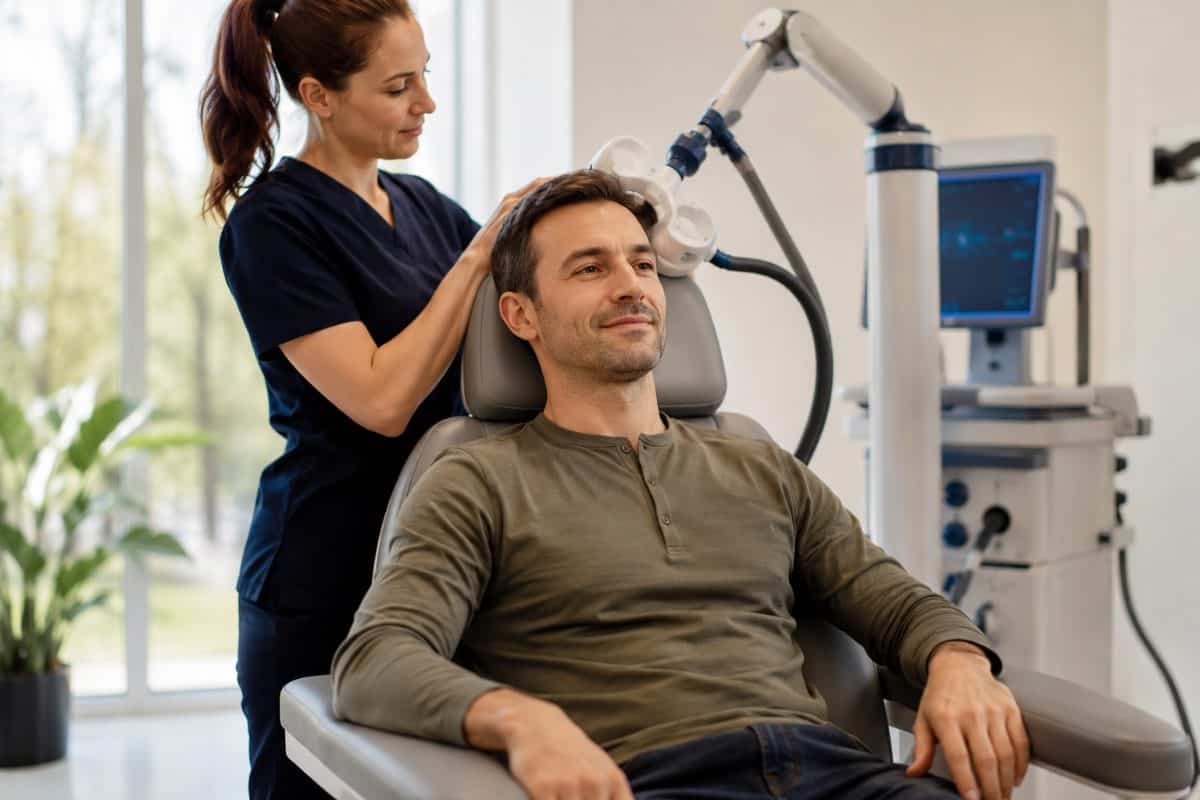
A MagVenture Stimulator is used to produce the magnetism that is applied to the head. A head wand is applied to specific areas on the head as the stimulator produces magnetism in five-second bursts. During this time, it is recommended that the patient sit still and close their eyes. We help patients acclimate to this and in our experience, patients of all ages and functioning quickly comply with treatment. There is a break of approximately 25 seconds, and our patients can eat snacks or watch their favorite show. Some struggle to sit still for 30 consecutive minutes, which can usually be accommodated and adapted to their needs. After approximately 10 treatment sessions, a follow-up EEG is done to measure the progress of the brain’s wave activity. EEG’s are repeated every two weeks to monitor the patient’s response to treatment.

  1. Treatment sessions are 30-35 minutes long
  2. They are Mon- Fri at the same time for 6-8 weeks. There is an opportunity to adjust a session for conflicts or illness, however, as much consistency in treatment as possible is the goal.
  1. The Dr. is also able to speak to you if you desire to do longer than the 6-week recommended sessions.
  2. During the first two to three weeks of treatment, it is possible to see some hyperactivity, need for movement, or increased agitation. Less commonly, brain stimulation makes patients sleepy, resulting in increased nighttime sleep. We ask that you contact us if it is unbearable and the treatment protocol can be slowed down for better acclimation.

Results
Results are widely varied, mostly in degree of improvement. In general, improvements in sleep, attention, speech, and sensory idiosyncrasies of all types are reported. It is important to note that improvements do continue in the months following treatment, and the end of treatment is an excellent time to begin new therapies and activities, as people often report that gains and improvements come much more rapidly after MeRT.

Read/view testimonials of those who have experienced results from this process.
 

MeRT machine render

Recent Posts

Also Read

A man sitting calmly in a quiet clinic consultation room considering TMS treatment for PTSD
Aug 26 2026

TMS for PTSD: What the Evidence Shows for Veterans and Civilians

PTSD is one of the conditions where the gap between what treatment can offer and what patients actually receive is widest. Trauma-focused psychotherapy works, and it...
A parent and teenage child sitting together in a bright clinic consultation room discussing TMS treatment options
Aug 19 2026

TMS for Teens: Age Limits, Evidence and What Parents Should Know

Parents who come to us about a teenager have usually been somewhere else first. There has been a diagnosis, one or two medication trials, therapy that helped somewhat...
Patient seated calmly in a TMS treatment chair wearing earplugs, with the magnetic coil arm positioned beside the headrest
Aug 12 2026

TMS Therapy Side Effects: What’s Common, What’s Rare, and How They’re Managed

Every patient who sits down for a TMS consultation asks some version of the same question: what is this going to do to me? It is a fair question, and it deserves a...
Adult patient receiving an accelerated TMS session in a modern clinic treatment chair
Jul 23 2026

Accelerated TMS Receives FDA Clearance: What It Means for Patients

The FDA has cleared accelerated TMS protocols for depression. Learn what changed, who may benefit, and why it matters for patients who travel for treatment.

Child receiving non-invasive magnetic brain stimulation session with a clinician and parent nearby
Jun 22 2026

Accelerated TMS for Autism: What Parents Should Know About Multiple Sessions Per Day

Accelerated TMS for autism explained: multiple sessions per day, theta burst stimulation, what new research shows, and what parents should know about safety.

A woman patient in a medical setting at Brain Performance Technologies, a center specializing in non-invasive brain treatments like MeRT for autism and brain health.
Jun 19 2026

Your First TMS Session: What to Expect

Your First TMS Session: What to Expect Starting any new treatment can feel intimidating, especially one that involves the brain. If you have scheduled transcranial...
A child and adult holding hands outdoors during fall, symbolizing support and care in brain health treatments at Brain Performance Technologies.
Jun 12 2026

MeRT for Autism: A Parent’s Guide to What to Expect

MeRT for Autism: A Parent's Guide to What to Expect If you are a parent exploring options for your child on the autism spectrum, you have probably encountered a lot of...
MRI scan of a human brain showing detailed neural structures, used for brain health assessment and treatment planning at Brain Performance Technologies.
Jun 05 2026

QEEG-Guided TMS for Anxiety: A Personalized Approach

TMS for Anxiety: Does It Work? A QEEG-Guided Approach Anxiety is one of the most common reasons people seek help, and for many it does not fully respond to medication...
Clinician fitting EEG cap as part of neurotechnology assessment for disorders of attention in a bright modern clinic
May 22 2026

qEEG Brain Mapping: What It Is and Why It Matters

Modern brain health care increasingly relies on data. Rather than treating every brain the same way, clinicians can now look at how an individual's brain is actually...
Comparison of MERT and TMS systems highlighting features like multimodal embedding, semantic understanding, and operational efficiency for enhanced brain performance.
May 19 2026

MeRT vs TMS: Understanding the Difference

If you have been researching non-invasive brain treatments, you have probably come across two terms that sound similar but are not quite the same: TMS and MeRT. Both...