What is MeRT?

by | May 12, 2023 | MeRT

I ran across MeRT in one of my social media groups.  My friend told me about it.  I have heard of TMS, but that is for depression.  My neurologist said it was a hoax.  There are no studies for it.  It is not FDA approved. 

Lots of chatter.  Lots of convolution of facts.  Here are the basics:

MeRT – stands or Magnetic eResonance Therapy.  It is a form of brain stimulation therapy that uses a magnet.  MeRT begins with a test to monitor brain waves, see qEEG/EKG.  The machinery used in MeRT is the same that is used in TMS (see below).  The machinery is FDA approved for some mental health conditions.  The protocol introduced by MeRT for this machinery is still undergoing clinical trials. 

Brain Stimulation Therapy – a type of therapy for the treatment neurological or psychiatric disorders that uses a certain conduit to stimulate areas of the brain not functioning as they should.  Electrodes or magnets are the two most common devices used in brain stimulation therapies.

TMS – transcranial magnetic stimulation, also known as repetitive transcranial magnetic stimulation, is also a form of brain stimulation that uses a magnet. The machinery used in TMS and MeRT are the same.  The protocols for TMS using these machines has been approved by the FDA as treatment for major depressive disorder that does not respond to medication, OCD, and smoking cessation.  It is used off label for other psychiatric disorders, including autism. 

qEEG/EKG – a quantitative electroencephalogram records electrical activity in the brain.  Done together with an electrocardiogram (EKG), these diagnostics provide comprehensive understanding of brain activity.   MeRT treatment uses the results of these tests to personalize brain stimulation therapy for each patient. 

MeRT and TMS use the same machine in treatment.  The difference is placement of the magnet and hertz frequency.  Magnet placement and hertz frequency are the same across every TMS treatment, but are personalized for each patient in MeRT. 

There are a wide range of studies and research for both MeRT and TMS.  Review them on our research page and check back for updates.  You can also check out our testimonials. 

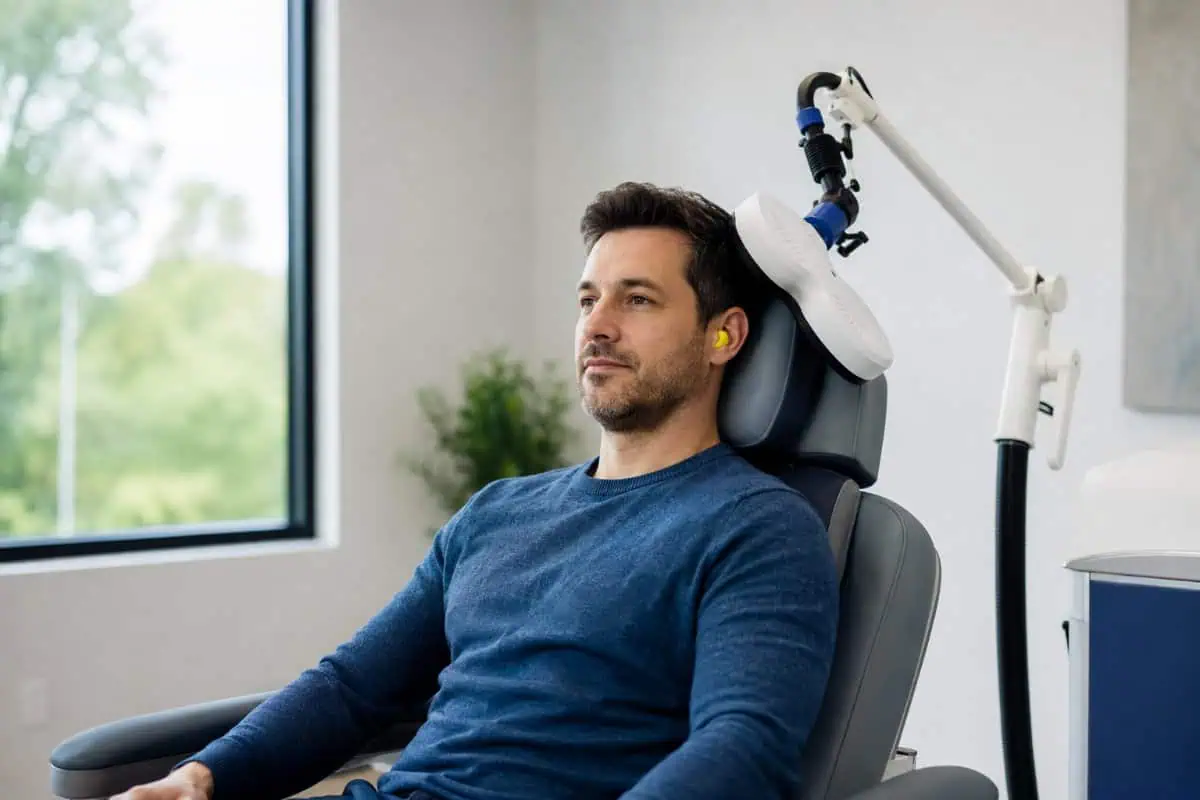
MeRT machine render

Recent Posts

Also Read

Softly lit living room with half-closed blinds, an armchair, a glass of water and sunglasses on a side table, suggesting light sensitivity during post concussion syndrome treatment
Oct 24 2026

Post-Concussion Syndrome Treatment: What Helps When Symptoms Don’t Go Away

There is no single cure for post-concussion syndrome, but most lingering symptoms respond to targeted care. Here is what the evidence supports, what it does not, and...
Dim restaurant at dusk seen from a back booth with a clear sightline to the front door and windows, illustrating hypervigilance
Oct 19 2026

Hypervigilance: What It Is, Why It Happens and How It’s Treated

Hypervigilance is a state of constant alertness for danger. It is a symptom rather than a diagnosis, most often linked to PTSD and anxiety, and it can be treated.

Home office desk with an open laptop, blank notepad, sticky notes and a cup of coffee, illustrating ADHD paralysis
Oct 15 2026

ADHD Paralysis: Why Your Brain Freezes and What Helps

ADHD paralysis is not laziness and not a formal diagnosis. It is a recognizable freeze in starting, choosing or prioritizing, and it responds to the right mix of...
Advanced brain treatment device with a chair and monitor displaying brain scans at Brain Performance Technologies.
Sep 24 2026

Theta Burst Stimulation: The Three-Minute TMS Session, Explained

When people hear that a TMS session can take three minutes, the first reaction is usually suspicion. A standard session runs closer to forty. It is reasonable to assume...
Modern brain treatment room with advanced neuroimaging equipment and a comfortable chair for non-invasive brain therapy at Brain Performance Technologies.
Sep 22 2026

TMS for ADHD: What the Evidence Does and Does Not Support

Most people who ask us about TMS for ADHD have already tried the standard path. Stimulants helped, or helped for a while, or brought side effects that were not worth...
A man sitting calmly in a quiet clinic consultation room considering TMS treatment for PTSD
Aug 26 2026

TMS for PTSD: What the Evidence Shows for Veterans and Civilians

PTSD is one of the conditions where the gap between what treatment can offer and what patients actually receive is widest. Trauma-focused psychotherapy works, and it...
A parent and teenage child sitting together in a bright clinic consultation room discussing TMS treatment options
Aug 19 2026

TMS for Teens: Age Limits, Evidence and What Parents Should Know

Parents who come to us about a teenager have usually been somewhere else first. There has been a diagnosis, one or two medication trials, therapy that helped somewhat...
Patient seated calmly in a TMS treatment chair wearing earplugs, with the magnetic coil arm positioned beside the headrest
Aug 12 2026

TMS Therapy Side Effects: What’s Common, What’s Rare, and How They’re Managed

Every patient who sits down for a TMS consultation asks some version of the same question: what is this going to do to me? It is a fair question, and it deserves a...
Adult patient receiving an accelerated TMS session in a modern clinic treatment chair
Jul 23 2026

Accelerated TMS Receives FDA Clearance: What It Means for Patients

The FDA has cleared accelerated TMS protocols for depression. Learn what changed, who may benefit, and why it matters for patients who travel for treatment.

Child receiving non-invasive magnetic brain stimulation session with a clinician and parent nearby
Jun 22 2026

Accelerated TMS for Autism: What Parents Should Know About Multiple Sessions Per Day

Accelerated TMS for autism explained: multiple sessions per day, theta burst stimulation, what new research shows, and what parents should know about safety.