Parents who come to us about a teenager have usually been somewhere else first. There has been a diagnosis, one or two medication trials, therapy that helped somewhat or not at all, and a year that felt much longer than a year. By the time TMS comes up, the question is rarely “what is this?” It is narrower and more urgent: is my child old enough, is there real evidence behind it, and what would it actually require of us?
This article answers those questions directly. It covers age limits and where they come from, what the adolescent evidence base does and does not show, how a course fits around school, and the practical questions that decide whether a family can realistically complete treatment.
Is There an Age Limit for TMS?
The short answer is that regulatory clearance and clinical practice are not the same thing, and understanding the gap between them removes most of the confusion families encounter online.
TMS devices for major depressive disorder were originally cleared in the United States for adults aged 18 and over. In March 2024 the FDA cleared the first TMS system as a first-line add-on treatment for adolescents aged 15 and older with major depressive disorder. Two things follow from the wording. Treating a 15-, 16- or 17-year-old is no longer an off-label decision in the way it once was. And because the clearance is first-line adjunctive rather than treatment-resistant, it permits use alongside medication from the outset rather than only after failed trials — though insurers, as below, frequently apply stricter criteria than the clearance does.
Below 15, TMS in depression is used off-label. Off-label is not a synonym for improper — a great deal of paediatric psychiatry is off-label, and prescribing outside a cleared indication is lawful and often appropriate. What it does mean is that the decision rests more heavily on clinical judgement, that the evidence base is thinner, and that insurance is considerably less likely to pay. Any clinic offering treatment to a younger child should be able to explain its reasoning without being asked twice.
What the Adolescent Evidence Actually Shows
Honesty is more useful than enthusiasm here, because families deserve to know how strong the ground is under a treatment decision.
Open-label studies and case series in adolescents with treatment-resistant depression have reported response rates broadly comparable to those seen in adults, with tolerability that is if anything slightly better. Adolescent brains appear to require, on average, somewhat lower stimulation intensities to reach motor threshold, which is consistent with the anatomical differences you would expect.
The complication is that the largest randomised sham-controlled trial in adolescents did not separate active treatment from sham on its primary endpoint — both arms improved substantially. That result is often quoted as a refutation, which overstates it: high sham response is a recognised feature of adolescent depression trials, and the finding is more a statement about trial design in this population than a demonstration that stimulation does nothing. But it is a genuine limitation, and the adolescent evidence base is thinner and less consistent than the adult one. A clinician who tells you otherwise is selling.
The practical implication is that TMS in a teenager is a reasonable option to weigh alongside or after medication and therapy, not a replacement for either. In most families the decision arrives after one or two medication trials have proved intolerable or insufficient. Our overview of how TMS compares with traditional treatments sets out where it sits in the wider sequence.
Why Families Consider It
The reasons parents give are consistent enough to be worth listing, because they are usually about the burdens of the alternatives rather than the appeal of stimulation itself.
- Medication side effects that are hard on a developing adolescent. Weight change, sedation and emotional blunting are difficult at any age and particularly costly during the years when identity and social life are being built.
- No systemic exposure. Stimulation is focal. It does not circulate, and it does not carry the metabolic or sexual side effects that drive many teenagers to quietly stop taking medication.
- The black box warning. Antidepressants carry a boxed warning regarding suicidality in patients under 25, and for some families that warning is the thing that has stalled treatment entirely.
- No cognitive burden. Unlike electroconvulsive therapy, TMS has not been associated with memory impairment, which matters enormously when the patient is in school.
What Treatment Looks Like for a Teenager
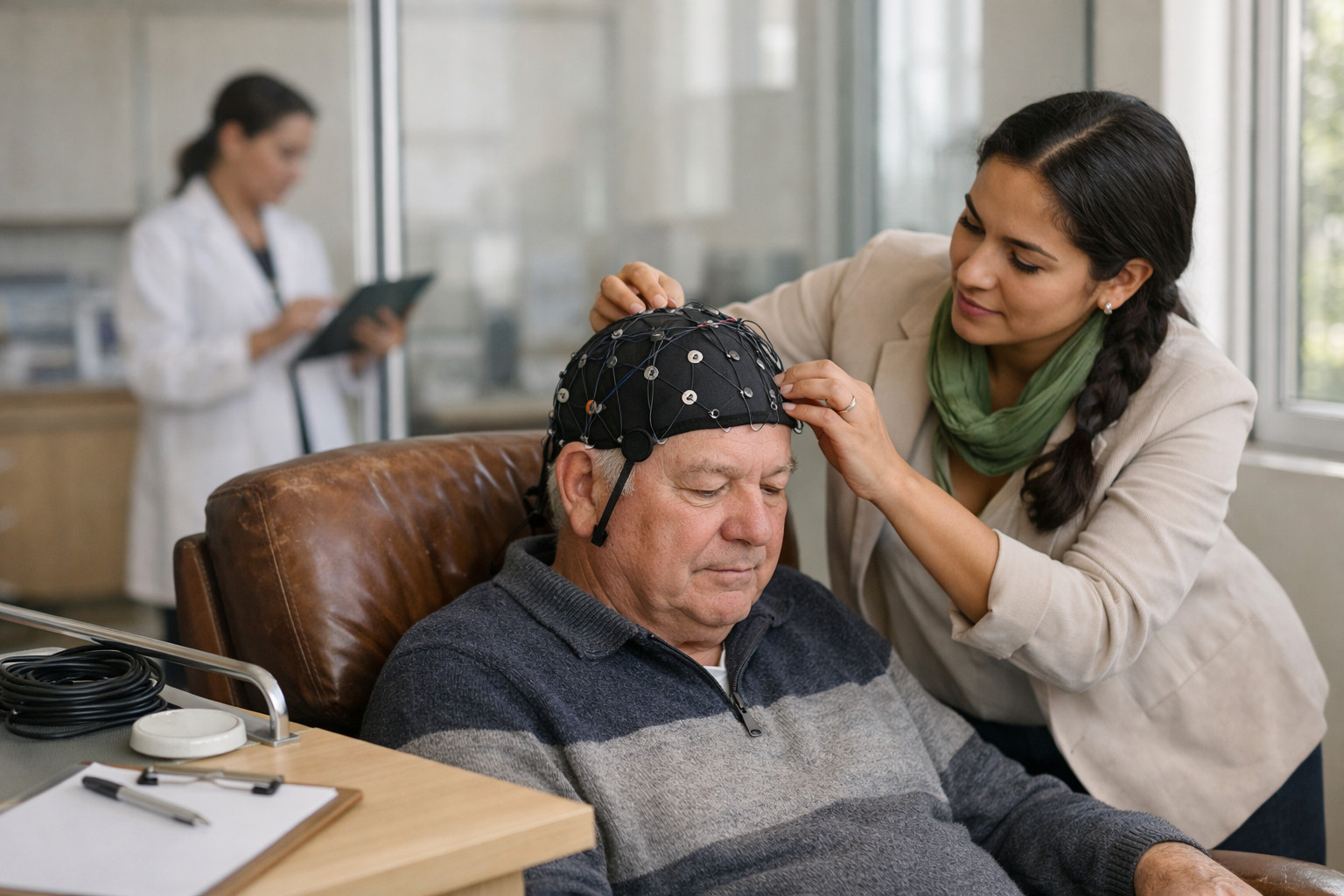
Mechanically, an adolescent course is the same as an adult one. The first appointment determines motor threshold and establishes coil positioning; subsequent sessions are short and routine. Your teen sits in a chair, awake, usually with headphones and a phone, and leaves without restriction. There is no sedation and no recovery period. Our walkthrough of what happens at a first TMS session applies directly.
What differs is everything around the treatment. A standard course runs five days a week for six weeks or so, and a teenager cannot drive themselves to most of those appointments. In practice the scheduling problem is the single biggest determinant of whether a family finishes. Early morning slots before school work best; mid-afternoon slots collide with sports, and families who plan around a 3 p.m. appointment tend to start missing sessions by week three.
Accelerated protocols, which deliver multiple sessions per day over a compressed number of days, are worth asking about for exactly this reason. They convert a six-week logistical problem into a short block that can sit inside a school holiday. The tradeoffs are covered in our article on accelerated TMS and what its FDA clearance means for patients.
Side Effects and Safety in Younger Patients
The profile is the same as in adults and is generally reported as mild: scalp discomfort at the treatment site during the first week, occasional headache, facial twitching during stimulation that stops when the pulse train stops. Hearing protection is mandatory at every session. Seizure risk is very low and is managed through the screening completed before treatment begins. We cover each of these in detail in our guide to TMS therapy side effects.
Two adolescent-specific points deserve emphasis. The first is manic switch: any effective antidepressant intervention can unmask bipolar illness, and bipolar disorder frequently declares itself in adolescence. A family history of bipolar disorder is important information to disclose, and a sudden collapse in sleep need is the sign most worth watching for. The second is that a teenager may under-report discomfort to avoid disappointing a parent who has clearly invested a great deal in this working. Asking directly and privately — and making clear that reporting discomfort leads to adjustment rather than to stopping — is worth doing in the first week.
Insurance and Cost for Adolescent Patients
Coverage for adolescents lags clearance, and it lags it unevenly. Some commercial plans have updated their criteria to reflect the expanded clearance for patients 15 and over; others still list an adult age floor. Expect to be asked for documentation of diagnosis, of failed medication trials at adequate dose and duration, and often of a course of psychotherapy.
Two things speed this up more than anything else. Bring a written medication history — drug, dose, dates started and stopped, and the reason for stopping — assembled from every prescriber your teen has seen. And ask the clinic directly whether they have obtained authorisation for adolescent patients with your specific carrier before, because a practice that has done it once knows what the reviewer wants. Military families will find our overview of Tricare and Blue Cross Blue Shield brain health coverage a useful starting point.
Questions Worth Asking a Clinic
- How many adolescent patients have you treated, and what is your youngest?
- Is the device you use cleared for adolescents, or would this be off-label?
- Who supervises the sessions, and what is their experience with this age group?
- What is your policy on a parent being present during treatment?
- How do you coordinate with my child’s existing psychiatrist and therapist?
- What happens if we need to pause for a school trip or illness?
Frequently Asked Questions
What is the minimum age for TMS therapy?
In the United States, TMS has been FDA-cleared since March 2024 as a first-line add-on treatment for major depressive disorder in adolescents aged 15 and older. Use below that age is off-label and is decided case by case.
Does TMS affect brain development?
No evidence of harm to development has emerged from adolescent studies to date, and cognitive testing has not shown deficits. Long-term follow-up data in this population remain more limited than in adults, which is a fair thing to weigh in the decision.
Will my teenager have to stop their antidepressant?
Usually not. TMS is typically delivered alongside existing treatment, and the adolescent clearance is specifically as an adjunct. Any medication change is made by the prescribing psychiatrist.
How much school will they miss?
With a before-school appointment, very little. Standard sessions are short and there is no recovery period, so a teenager can go straight from the clinic to first period. Accelerated protocols can be scheduled into a break instead.
Is TMS used for anything other than depression in teens?
Protocols exist for OCD and are being studied in other conditions. Our articles on TMS for OCD and accelerated approaches in autism cover those applications.
Deciding Whether It Is Right for Your Family
TMS is a reasonable option for an adolescent whose depression has not responded to adequate medication and therapy trials, who is 15 or older, and whose family can realistically get them to a clinic five days a week for six weeks or complete an accelerated block. It is not a first step, and it is not a substitute for therapy. Where it earns its place is with the teenager who is out of tolerable medication options and whose family has been told there is nothing left to try.
This article is for general education and is not individual medical advice. Decisions about treating a minor should be made with the child’s psychiatrist and a clinician who has evaluated them directly. If your child is in crisis, call or text 988 in the United States.