If you have been researching non-invasive brain treatments, you have probably come across two terms that sound similar but are not quite the same: TMS and MeRT. Both use magnetic stimulation, both are non-invasive, and both are used to support brain health. So what actually separates them? Understanding MeRT vs TMS helps you ask better questions and make a more informed decision about your care.
At Brain Performance Technologies, we offer personalized, technology-driven approaches to brain health, and we frequently help patients understand how these options relate to one another. Here is a clear, honest breakdown.
What Is TMS?
TMS, or transcranial magnetic stimulation, is a non-invasive treatment that delivers focused magnetic pulses to specific regions of the brain through a coil placed against the scalp. It requires no surgery, anesthesia, or sedation, and it has been cleared by the FDA for conditions including major depressive disorder and, in a specific deep TMS form, obsessive-compulsive disorder.
Standard TMS protocols use established settings: a target region, a stimulation frequency, and a treatment schedule that are based on clinical guidelines for the condition being treated. In other words, conventional TMS applies a well-defined, evidence-based protocol to each patient with a given diagnosis.
What Is MeRT?
MeRT stands for Magnetic e-Resonance Therapy. It is a personalized approach that builds on the same core technology as TMS but adds a layer of individualization. Rather than applying a single standardized protocol, MeRT uses diagnostic testing to tailor the stimulation to each person’s unique brain activity.
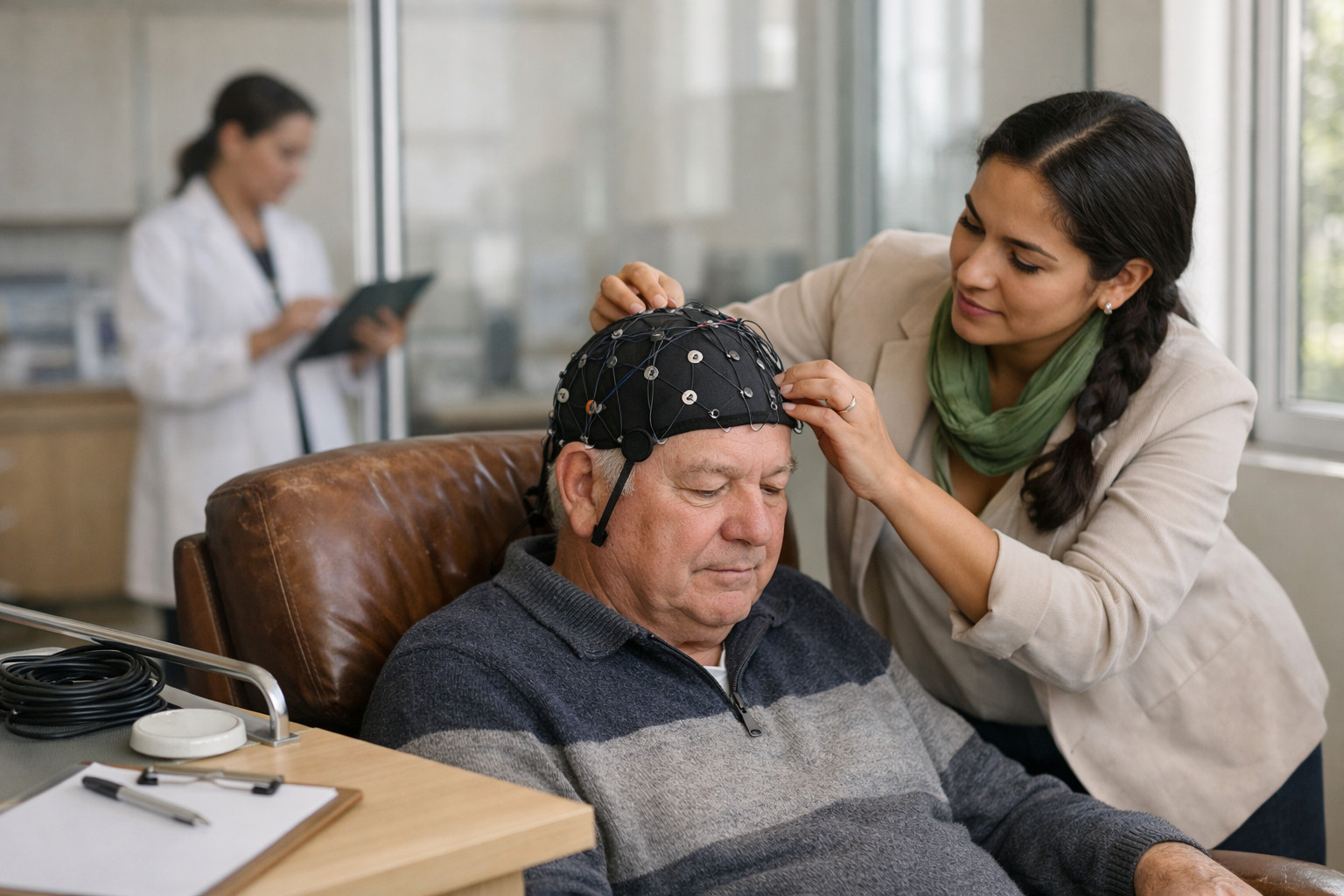
The key difference is personalization. Before treatment, MeRT involves recording your brain’s activity, typically with a quantitative EEG (qEEG) and sometimes an EKG, to map how your brain is functioning. That data is then used to guide the stimulation settings, with the goal of encouraging healthier, more organized brainwave patterns specific to you.
It is important to be precise and honest here: MeRT is an individualized way of applying magnetic stimulation, using FDA-cleared equipment, but the personalized MeRT protocol itself is offered as a tailored clinical approach rather than a separate, distinct FDA-cleared treatment. A good provider will explain exactly what the evidence supports for your situation.
MeRT vs TMS: The Core Difference
The simplest way to understand the distinction is this: standard TMS applies a proven protocol based on your diagnosis, while MeRT customizes the protocol based on your individual brain activity.
Think of it like the difference between a well-fitted off-the-rack approach and a made-to-measure one. Standard TMS follows guidelines developed from large clinical studies, which is a real strength. MeRT adds individual brain mapping to personalize the settings to you specifically. Neither is universally “better”; they represent different philosophies, and the right choice depends on your situation and goals.
If you want to understand the foundation that makes personalization possible, our overview of how brain wave therapy enhances cognitive function explains the role brainwave activity plays.
The Role of qEEG in MeRT
The personalization in MeRT comes from the qEEG, or quantitative EEG. This is a recording of your brain’s electrical activity that is analyzed to identify patterns, including areas that may be over- or under-active or out of sync with the rest of the brain.
This brain map is what allows MeRT to be tailored. Instead of assuming every brain with a given diagnosis should receive identical stimulation, MeRT uses your individual data to inform the approach. The qEEG is also repeated over the course of treatment to track changes and adjust the plan, making it a dynamic, data-guided process.
What Are They Used For?
Standard TMS is most established for major depressive disorder and OCD, with growing use for related conditions. MeRT, because of its personalized nature, is offered for a broader range of conditions where individual brain activity patterns are relevant, and our practice has applied it across various neurological and mental health concerns. Our discussion of the benefits of MeRT treatment goes deeper into where it fits.
As always, whether either approach is appropriate for a specific condition is a clinical decision that should be made after a proper evaluation, and the strength of the evidence varies by condition.
What to Expect
Both treatments share a similar in-office experience. You sit comfortably while a coil delivers magnetic pulses to the targeted area. You stay awake, feel a tapping sensation, and can return to normal activities afterward. Sessions are typically scheduled over several weeks.
The main experiential difference is the diagnostic component. With MeRT, you begin with brain mapping before treatment starts, and that mapping is revisited during the course to guide adjustments. Standard TMS uses a setup process to position the coil and set parameters according to the established protocol.
Side Effects and Safety
Because both approaches use the same fundamental technology, their safety profiles are similar. Both are non-invasive and generally well tolerated, with the most common side effects being mild and temporary, such as scalp discomfort or a mild headache that tends to fade early in treatment. Serious side effects are rare when treatment follows established safety guidelines. A thorough screening for factors like seizure history or metal implants near the head is part of responsible care for either option.
A Note on How Magnetic Stimulation Developed
Magnetic stimulation of the brain has a substantial clinical history. Transcranial magnetic stimulation emerged as a way to influence brain activity non-invasively, and over the years it earned FDA clearances for specific conditions as the evidence accumulated. Standard TMS protocols are the product of that research: defined targets, frequencies, and schedules validated in clinical studies.
MeRT grew out of the same technological lineage but with a different emphasis. Where standard TMS asks, “what protocol does the evidence support for this diagnosis?”, MeRT adds the question, “what does this particular brain look like, and how can the stimulation be tailored to it?” Both questions are valuable. Understanding that they come from the same foundation, but apply it differently, is the key to making sense of the comparison. It also explains why the two share so much in terms of the in-office experience and safety profile while differing in their diagnostic and personalization steps.
Questions Worth Asking Your Provider
Because MeRT and TMS differ in their approach, it helps to come to a consultation with good questions. You might ask what the evidence specifically supports for your condition, whether standardized TMS or a personalized approach is more appropriate for you, and what the full course of treatment would involve in terms of time and sessions. It is also reasonable to ask how progress will be measured, and, in the case of MeRT, how the brain mapping will be used to guide and adjust your plan.
A trustworthy provider will welcome these questions and answer them honestly, including being clear about what each approach can and cannot offer. That kind of transparent conversation is the best foundation for choosing the right path, and it matters far more than the name attached to the treatment.
Which One Is Right for You?
There is no single answer that applies to everyone. Standard TMS may be the clearest path when there is a strong, condition-specific evidence base and an established protocol. MeRT may appeal to those who want a more individualized, data-guided approach tailored to their own brain activity.
The most important factor is not the label but the quality of the evaluation and the expertise behind the treatment. A good provider will assess your specific situation, explain honestly what each option can and cannot offer, and recommend the approach that gives you the best chance of meaningful results.
Take the Next Step
Choosing between MeRT and TMS is easier when you understand what actually separates them: standardized, evidence-based protocols versus personalized, brain-mapping-guided treatment. Both are non-invasive, both use proven magnetic stimulation technology, and both aim to support healthier brain function.
To find out which approach fits your goals and your situation, reach out to the team at Brain Performance Technologies for a personalized evaluation.
Frequently Asked Questions
Is MeRT the same as TMS? MeRT uses the same core magnetic stimulation technology as TMS but adds qEEG-based personalization to tailor the treatment to your individual brain activity. Standard TMS applies an established protocol based on your diagnosis.
Does MeRT use a brain scan? Yes. MeRT involves a quantitative EEG (qEEG) to map your brain’s activity, and that map guides the personalized treatment settings.
Is TMS FDA-cleared? Yes, TMS is FDA-cleared for conditions including major depressive disorder and, in a deep TMS form, OCD. MeRT is a personalized application of magnetic stimulation using cleared equipment.
Which one should I choose? It depends on your condition, history, and goals. A proper evaluation with a qualified provider is the best way to decide.
Are the side effects different? Because both approaches use the same core magnetic stimulation technology, their safety and side-effect profiles are similar, with most effects being mild and temporary. Your provider screens for the same safety factors in either case.
This article is for educational purposes and is not a substitute for personalized medical advice. Always consult a qualified healthcare provider about your specific situation.