When behaviors blur: how often ADHD and autism co-occur
A single data point makes the “either-or” mindset hard to defend: in a large national cohort highlighted by Drexel, adults with autism had ADHD rates about 10 times higher than the general population, and that elevation persisted into adulthood, not just childhood (research summary from Drexel University). In day-to-day practice, that overlap is why you’ll hear the term AuDHD, shorthand for someone who meets criteria for both.
Timing changes what gets noticed first. A UC Davis report for clinicians described a pattern many families recognize: early autism identification can strongly predict a later ADHD diagnosis, often once school demands expose strain in attention, planning, and impulse control (UC Davis clinician-focused research update). The sequence can flip, too, especially when hyperactivity triggers the first referral and social-communication differences get written off as “behavior” until a more autism-informed evaluation happens.
Masking and gender expectations complicate the picture. Girls and women are more likely to camouflage social difficulty, and high verbal ability can hide support needs until adolescence, when workload, peer complexity, and anxiety spike. That’s one reason an adhd autism diagnosis is often delayed in bright students who “hold it together” all day and then unravel at home.
Prevalence isn’t just academic. It influences what services get funded, what school supports are approved, and which research questions get prioritized. It also changes treatment planning: when both are present, we’re not simply stacking two playbooks, we’re building a coordinated plan with clear targets, measurable outcomes, and realistic expectations about what tends to improve first.
Some families also want to explore non-invasive options alongside skills work and, when appropriate, medication. In our clinics in San Jose, Las Vegas, and Sacramento, we may discuss brain stimulation approaches such as MeRT, TMS (often covered by insurance), and the SAINT protocol, when they fit the clinical picture and goals. If you’re exploring that route, our team can walk you through what’s known, what’s still emerging, and whether a program like Mert for autism is a reasonable next step. The aim stays the same: improve day-to-day functioning, not chase a perfect label.
Shared traits and critical differences: parsing overlapping symptoms
If you’ve ever wondered why two clinicians can look at the same behaviors and land on different conclusions, here’s the core issue: ADHD and autism share enough surface-level traits that a checklist can mislead you. Both can involve distractibility, emotional reactivity, sensory overwhelm, and social friction. The difference is usually the “why” underneath the behavior, and that’s what a careful dual evaluation tries to clarify.
Here’s a practical comparison clinicians use when sorting overlap from true convergence:
| Symptom domain | Often looks like (both) | More typical in ADHD | More typical in Autism (ASD) |
|---|---|---|---|
| Attention/executive function | Missed steps, late work, disorganization | Novelty-seeking distractibility, inconsistent focus, impulsive task-switching | “Stuck” attention, difficulty shifting sets, overload-driven shutdown |
| Social communication | Interrupting, awkward timing, conflict | Social intent is there, errors come from impulsivity or inattention | Differences in social reciprocity, reading subtext, pragmatic language |
| Sensory regulation | Avoidance, irritability, meltdowns | Sensory seeking plus movement to self-regulate | Sensory sensitivities, predictability needs, narrow tolerances |
| Repetitive behaviors/motor | Fidgeting, pacing | Restlessness, boredom-driven movement | Repetitive routines, stimming for regulation, insistence on sameness |
A quick caveat: “typical” patterns are helpful, but real people don’t read the textbook. Anxiety, sleep disorders, trauma exposure, and learning differences can mimic, or amplify, both presentations, which is why a one-visit opinion is rarely enough.
Attention and executive function — how distractibility, working memory deficits, and planning problems present differently in ADHD vs ASD
In ADHD, executive-function problems often show up as inconsistent performance. Someone can hyperfocus on a preferred task and then feel inexplicably unable to start the boring one, even when they care about the consequences. Working-memory lapses look like, “I walked upstairs and forgot why,” or losing the thread mid-sentence, then compensating with speed and improvisation.
Autism can produce a different executive profile. Planning may be strong inside a familiar routine, but shifting gears is costly. The “distractibility” is sometimes not pulled by novelty; it’s pushed by overload: too many inputs, too many choices, and the system freezes. In adults, network-based work also suggests traits cluster differently person-to-person, which helps explain why two people with the same labels can function very differently in daily life.
Consider a common scenario: a teen who “refuses” homework. With ADHD, it’s often task initiation plus low reward value. With autism, it may be that the assignment is underspecified (too many possible right answers), and the student can’t tolerate the ambiguity.
Social behaviors — distinguishing social intention deficits (ASD) from social inattention or impulsive social errors (ADHD)
Social difficulty is common in both, but the mechanism diverges. In ADHD, the intent is typically connection, and the problem is timing and self-monitoring: interrupting, oversharing, missing cues because attention drifted, or making a joke before thinking it through.
In autism, the challenge is more about social communication itself. That can mean difficulty reading implied meaning, sarcasm, or shifting conversational rules across contexts. Someone may want friends deeply, but the “map” of reciprocity is harder to access in real time, especially under stress.
A small but telling detail: if you replay the interaction, many people with ADHD say, “I knew better, I just didn’t pause.” Many autistic individuals say, “I didn’t realize that’s what they meant,” or “I didn’t know the rule changed.”
Sensory and motor features — when sensory sensitivities point toward ASD, and when hyperactivity points toward ADHD
Hyperactivity in ADHD is often regulation through movement. The body is chasing stimulation to stay online, which is why sitting still can feel physically uncomfortable. You’ll see foot tapping, chair rocking, constant repositioning, and a strong drive to move.
Sensory features in autism are frequently more specific and more intense. Certain sounds, fabrics, lights, or crowded environments can be genuinely painful or disorganizing. Repetitive movements (stimming) aren’t just “extra energy”, they’re often a stabilizer, a way to keep the nervous system from tipping into shutdown or meltdown.
Treatment planning gets practical here. If sensory overload is the driver, you prioritize environmental supports, predictable routines, and targeted coping skills. If impulsivity and motor restlessness dominate, you focus on executive-function coaching, behavioral strategies, and when appropriate, medication. Some patients also ask about non-invasive neuromodulation used in mental health settings; in our practice, that can include MeRT, TMS, and the SAINT protocol as part of a personalized plan, with TMS often covered by insurance. When it’s clinically appropriate and aligned with measurable goals, we may also point families to options like Mert for autism as a next step in care.
Key Takeaways
- ADHD and autism often co-occur, so track both symptom sets early to avoid delayed supports and misdirected services.
- For an adhd autism diagnosis, compare attention, social intent, sensory sensitivities, and repetitive behaviors to pinpoint the right mechanisms.
- Don’t rely on screeners alone, gather parent, teacher, and self reports and watch for masking and informant discrepancies.
- Use a stepwise plan: multi-source intake, prioritize safety and sleep, then choose behavioral supports and medication sequencing.
- If considering MERT, qEEG brain mapping, neurofeedback, TMS, or tDCS, verify evidence, safeguards, and realistic goals.
- Seek combined assessment when symptoms resist treatment or social delays persist alongside executive dysfunction in children or adults.
Why diagnosis is hard: clinical, diagnostic, and systemic challenges
DSM-5 technically makes co-diagnosis straightforward on paper because it explicitly allows both conditions to be diagnosed together. In real clinics, it’s messier. The same outward behavior can come from very different drivers: a child who “doesn’t listen” might be inattentive from ADHD, overloaded by sensory input, confused by pragmatic language demands, or anxious and shut down.
Here’s the deeper problem: DSM-5 descriptions are behavior-based, not mechanism-based, so they don’t tell you why the symptom is showing up. Add development into the mix and the presentation shifts again. Hyperactivity often softens into internal restlessness in adults, while autistic social differences can become more subtle as people learn scripts and coping strategies.
A timing issue adds another layer. A large clinical update from UC Davis noted that early autism identification strongly predicts later ADHD identification, which fits what many families experience: autism gets recognized first, and then attentional and executive-function needs become obvious when school demands ramp up (UC Davis Health clinician insights on autism and ADHD).
Common assessment pitfalls
The first pitfall is leaning too hard on screening tools. Screeners are meant to flag risk, not settle a diagnosis, yet they’re often treated as if a cutoff score equals certainty. The CDC is explicit that there’s no single test for ADHD and that clinicians need multi-source, multi-setting information to reduce false positives and false negatives (CDC guidance on diagnosing ADHD).
Informant discrepancies are the second trap. Parents may report constant dysregulation at home, while teachers see a quiet, compliant student. Adults often describe “high-functioning” coping that collapses after work, when the masking stops. When reports don’t match, it usually means the environment is changing the load on attention, sensory processing, and social demands, not that someone is being dishonest.
Masking is the third issue, and it’s a major reason misdiagnosis happens. Many patients can look “fine” in a 45-minute office visit, then describe needing hours to recover from the effort of appearing typical.
Systemic barriers
Most systems still run in silos. Autism services may focus on communication and behavior supports. ADHD services may focus on medication management. Mental health clinics may focus on anxiety or depression without a full neurodevelopmental workup. For some families, exploring options like Mert for autism comes only after years of fragmented care and trial-and-error.
Access is another choke point. Specialists who can confidently evaluate co-occurring presentations are limited, waitlists are long, and adults are often told they’re “too successful” to qualify for assessment. Gender bias adds fuel to the fire: females and high-masking individuals are more likely to be overlooked or labeled with primary anxiety instead of neurodevelopmental differences.
Delayed or incorrect labeling has real costs: inappropriate treatments, missed school and workplace supports, and higher rates of comorbid anxiety and depression. When the core picture is missed, patients can look “treatment-resistant” because the plan targets the wrong mechanism, not because they’re unwilling or unmotivated.
What links ADHD and autism: genetics, brain networks, and environment
The overlap isn’t just superficial. Many of the same underlying risk factors can express as ADHD, autism, or both depending on developmental timing and context. That’s why a combined presentation isn’t rare, it’s often the most accurate description of what’s going on.
Genetic overlap: shared risk and polygenic loading
Genetically, the story is polygenic. There isn’t one “ADHD gene” or one “autism gene.” Instead, many variants each nudge risk a little, and those variants overlap. Family patterns reflect that: relatives may show different expressions, one person with classic inattentive symptoms, another with social-communication differences, another with both.
In practice, this matters because it reframes prognosis and planning. If a patient has strong family loading for both, we anticipate more persistent executive-function challenges and plan supports earlier rather than waiting for repeated failures to make the case.
Neurobiology: convergent neural circuits, qEEG, and connectivity
At the brain-network level, both conditions commonly involve differences in attention regulation and cognitive control. Findings often converge on large-scale circuits, including frontoparietal attention systems and default mode network regulation, alongside differences in social-brain processing that can affect interpretation of cues and reciprocity.
Adult research examining trait-level overlap suggests the relationship isn’t “all or nothing.” Instead, specific features cluster and interact, which helps explain why two people with the same labels can look completely different day to day (network analysis of adult autism–ADHD overlap on ScienceDirect).
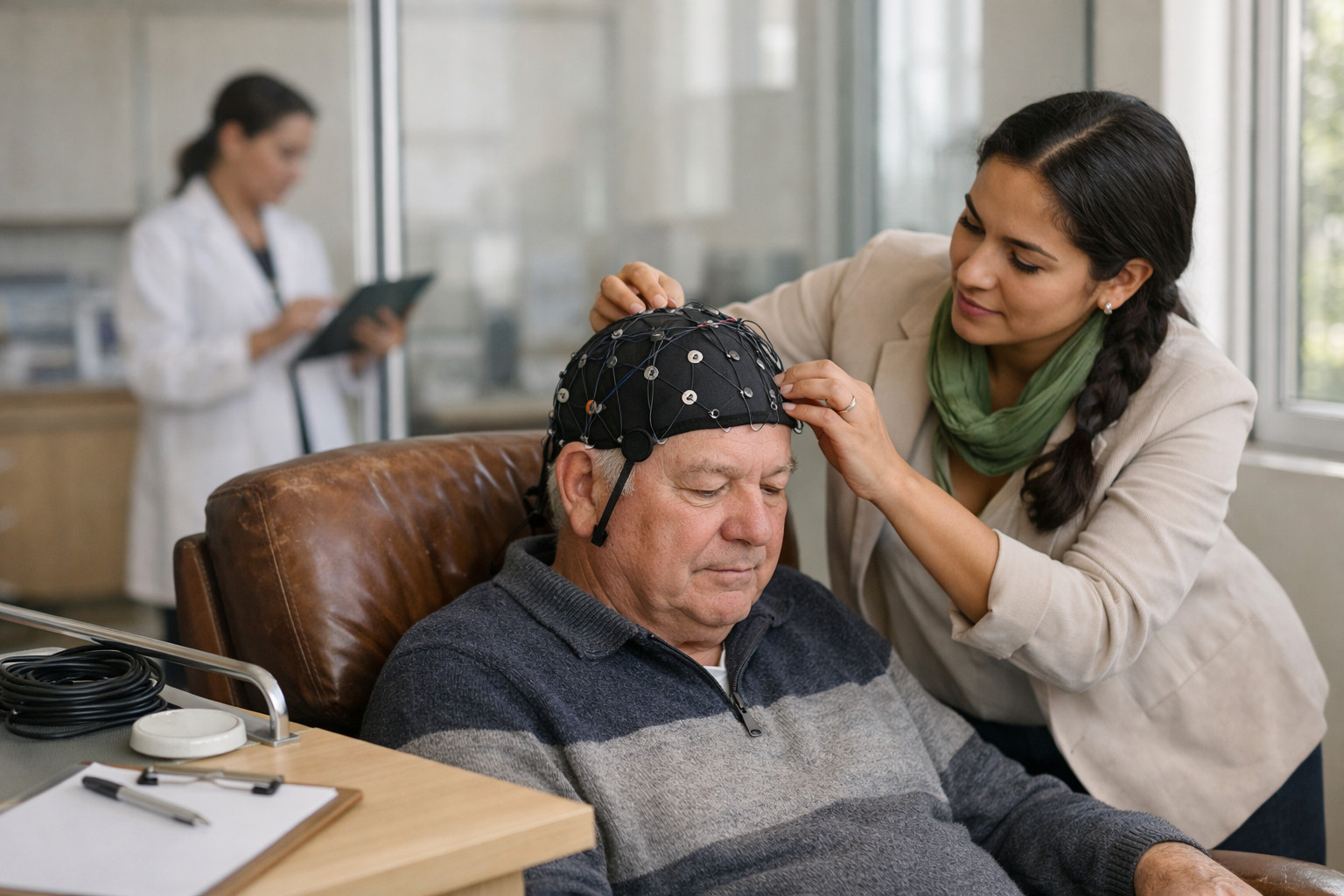
Clinically, some practices use qEEG as one data stream to look for patterns that may align with attention dysregulation or arousal instability. It’s not a standalone diagnostic tool, but it can be useful for treatment selection when paired with a careful history and functional assessment. The key isn't overpromising what a brain map can do, an honest limitation is that qEEG findings can be non-specific and vary by lab methods, so results should be interpreted cautiously and always in context.
Environmental and developmental contributors
Development and environment shape expression. Perinatal factors, early sleep disruption, chronic stress, and repeated social failure can amplify symptoms over time, especially when supports are delayed. The nuance is gene, environment interplay: the same stressor won’t affect every nervous system the same way, but a more vulnerable system may show a bigger functional impact.
For treatment planning, this is where one-size-fits-all falls apart. Some patients do well with standard behavioral and skills-based interventions. Others need a more personalized plan that targets arousal, sleep, and attention regulation first, because learning doesn’t stick when the nervous system is constantly overloaded.
When we consider newer options, including non-invasive brain stimulation protocols, the conversation should stay grounded: what’s FDA-approved, what’s off-label, what outcomes are realistic, and how we’ll measure effectiveness in real life (school performance, work consistency, fewer shutdowns), not just symptom checklists. Vanderbilt’s discussion of the lived experience of dual diagnosis captures this complexity well, especially the way traits can hide each other until demands increase (Vanderbilt’s overview of AuDHD and dual diagnosis dynamics).
Neurotechnology in shared care: MERT, brain mapping therapy, and other neuromodulation
MERT is a term that gets used loosely in neurodevelopmental care, so it’s worth slowing down and defining what a clinic actually means. In practice, most families are hearing “MERT” to describe a non-invasive, EEG-guided form of brain stimulation where a person’s brainwave patterns help shape stimulation parameters and the session plan. Some providers expand the acronym differently (you’ll hear “Multiple Element Reorganization Therapy” or variations), but the core idea is consistent: personalized care built around brain mapping, delivered through repeated sessions with structured protocols.
The evidence base is still emerging. We do have solid research showing ADHD and ASD traits intertwine at a symptom level, attention, inhibition, sensory reactivity, and social cognition, including adult network analyses that map how these features cluster and reinforce each other (trait-level overlap research in adults published on ScienceDirect). That overlap is one reason neuromodulation is being explored: it aims at regulation and arousal systems rather than trying to “train” one behavior at a time. One honest caveat: “promising” isn’t the same as “proven,” and response can vary meaningfully with language level, co-occurring anxiety, sleep quality, and whether someone is treatment-resistant to standard supports.
In our world, outcomes that matter are concrete and trackable: fewer meltdowns, faster sleep onset, improved classroom stamina, less impulsive aggression, and more flexible transitions. If a provider can’t tell you what they measure, and when, they’re selling a story, not a treatment plan.
What is brain mapping therapy?
“Brain mapping therapy” usually refers to a qEEG-guided assessment (quantitative EEG) that compares a person’s brainwave patterns to age-based norms, then uses that data to guide neurofeedback or other neuromodulation decisions. In brain mapping therapy for autism, the goal isn’t to “normalize” a child. It’s to identify patterns that correlate with symptoms, hyperarousal, underarousal, poor network coordination, or frontal slowing that can show up as inattention and low initiation.
Neurofeedback is the workhorse here. Sessions often run 30, 45 minutes, 2, 3 times per week, commonly organized in 20, 40 session blocks with periodic re-checks. Mechanistically, it’s operant conditioning for the nervous system: the brain gets real-time feedback and gradually learns to shift toward more stable regulation. Some families notice early changes around weeks 3, 4 (sleep and irritability often shift first), with attention and endurance improving later as routines stabilize.
If you’re exploring MERT-type services, look for programs that integrate mapping with structured safeguards and clear outcome tracking, like Mert for autism, within a broader mental health and neurodevelopmental care plan, not as a standalone “fix.” In our clinics (San Jose, Las Vegas, and Sacramento), we also discuss adjacent options such as TMS and the SAINT protocol when appropriate, especially when mood, attention, or regulation symptoms are limiting progress. TMS is also covered by insurance for qualifying indications, which can matter for families trying to balance evidence, access, and cost.
Complementary neuromodulation tools, tDCS, TMS, and conventional neurofeedback: what evidence exists for ADHD, ASD, or both?
Here’s the practical landscape clinicians tend to use when discussing tools and expectations:
| Tool | What it's | Typical use cases in ADHD/ASD care | Evidence strength (real-world take) | Practical notes |
|---|---|---|---|---|
| Neurofeedback | EEG-based training (no stimulation) | Attention regulation, arousal, sleep, emotional control | Moderate for ADHD, mixed for ASD, best when outcomes are measured tightly | Time-intensive, depends heavily on protocol quality and coaching |
| tDCS | Low-intensity direct current stimulation | Experimental support for attention/executive function, sometimes irritability | Early-stage, heterogeneous results | Cheap devices exist, but DIY is a bad idea, dosing and montage matter |
| TMS | Magnetic stimulation (clinic-based) | ADHD symptoms, mood comorbidity, some ASD-related targets under study | Strongest for depression; ADHD/ASD still developing | Equipment is FDA-cleared for specific indications, not broadly for autism core symptoms |
| MERT-style EEG-guided stimulation | EEG-informed stimulation plan (varies by provider) | Regulation, sleep, attention, behavioral volatility | Emerging, provider-dependent | Ask exactly what device is used and what “FDA-approved” refers to (device vs indication) |
A key reality: “FDA-approved” often applies to a device class or a specific indication (for example, depression for certain TMS systems), not automatically to “autism treatment.” A good clinic will say that plainly, document it in consent, and keep goals anchored to measurable targets (sleep, irritability, attention, functional stamina), not marketing language.
Risks, limitations, regulatory status, and practical considerations for families
What’s the tradeoff? Neuromodulation is non-invasive, but it’s not “no-risk.” Common issues include headaches, fatigue, irritability spikes, sleep disruption, and symptom substitution (one behavior improves while anxiety increases). If there’s a seizure history, you want explicit screening, coordination with neurology when appropriate, and conservative ramping.
Provider evaluation is where families win or lose. Ask these questions, and don’t accept vague answers:
- What exact assessment is used (qEEG montage, artifact handling, norms database), and who interprets it?
- What protocols are used, how are they individualized, and what triggers a protocol change?
- What outcomes are tracked (rating scales, sleep logs, school data), and at what intervals?
- What’s the plan if symptoms worsen for 1, 2 weeks?
- How do you coordinate with medication prescribers, school teams, OT/SLP, and psychotherapy?
Realistic expectations matter. Neuromodulation can improve regulation and attention, which may increase responsiveness to behavioral therapy and school supports, but it won’t teach social communication skills by itself. It also won’t fix a chaotic sleep schedule without behavioral structure. Treat it as one tool inside a broader plan, not the whole toolbox. If you’re considering options like MeRT, TMS, or SAINT, our team can walk you through candid eligibility, timelines, and what “success” would look like in 8, 12 weeks, with clear stop rules if it’s not helping.
A step-by-step pathway for assessment and treatment planning
When an adhd autism diagnosis is on the table, the fastest way to get stuck is to argue about labels before you’ve mapped function. Here’s a pathway that keeps it clinical, measurable, and family-friendly.
-
Intake and multi-source symptom mapping
A strong evaluation starts with a timeline, not a checklist. Document developmental history, regression (if any), sleep, sensory profile, medical issues, and family psychiatric history. Then add structured tools: ADOS-2 and/or ADI-R for autism features, plus Conners or BASC for attention, impulsivity, mood, and adaptive skills. Teacher reports matter, because “can’t sit still” at school is a different problem than “can’t transition” at home. For the nuts-and-bolts of ADHD evaluation, the CDC’s overview of how clinicians diagnose ADHD and rule out look-alikes is a solid reference point. -
Prioritize immediate functional targets before long-term goals
Safety first, always. That means elopement risk, self-injury, aggression, severe sleep disruption, and school refusal get addressed before you chase fine-motor gains or “better social skills.” Many families lose months targeting the loudest symptom rather than the most impairing driver, for example, trying to reduce stimming when chronic sleep deprivation is fueling daily blowups. -
Select interventions with sensible sequencing
Behavioral supports are usually first-line: parent coaching, school accommodations, and skills-based therapies (OT for sensory-motor regulation, SLP for pragmatic language when relevant). If medication is needed, sequence it thoughtfully, especially when anxiety, tics, or sleep problems complicate the picture. Neurotechnology can be considered when symptoms persist, when attention/arousal dysregulation blocks learning, or when someone is treatment-resistant to standard approaches. That’s where brain mapping therapy for autism may help clarify whether regulation patterns support adding neurofeedback or an EEG-guided stimulation approach like MeRT. In our clinics, we also evaluate whether TMS (including insurance-covered pathways when applicable) or SAINT-style accelerated protocols make clinical sense for co-occurring mood and regulation challenges that often travel with ADHD/autism presentations. -
Monitor outcomes, adjust, and coordinate the team
Pick 3, 5 objective measures and stick to them: rating scales every 4, 6 weeks, sleep onset/awakening logs, frequency counts of aggression, classroom engagement minutes, and targeted adaptive skills. If qEEG is used, treat it as one data stream, not the scoreboard. Coordination is what improves effectiveness. A prescriber changing meds without school feedback is flying blind.
Informed consent and measurable goals checklist
- What problem are we targeting (in plain language), and what does “better” look like in 8, 12 weeks?
- What are the known risks, common side effects, and stop rules?
- What’s the plan for setbacks, including who to call and how quickly you’ll respond?
- How will outcomes be recorded and shared across the mental health, school, and therapy teams?
Real-world examples and red flags: when to seek combined assessment
Picture this: a child (or adult) finally gets one label, everyone exhales, and daily life still doesn’t work. That’s the moment to consider whether you’re dealing with a dual presentation rather than a single-condition explanation.
Vignette (child): A 7-year-old is referred for ADHD after constant blurting, fidgeting, and incomplete classwork. Stimulants help seat time, but the meltdowns at transitions and the “plays next to kids, not with them” pattern don’t budge. A combined workup reframes it: ADHD plus autism, with language-pragmatics and sensory overload driving the blowups. Treatment shifts to personalized care: school supports for executive function, social communication goals, and home routines that reduce triggers, not just higher doses or more medication trials.
Vignette (adult): A 29-year-old has “treatment-resistant” anxiety and depression plus chronic disorganization. They’ve tried multiple SSRI/SNRI protocols with limited benefit. The missing piece is late-recognized autism traits (masking, shutdowns after social overload) alongside ADHD. Once both are assessed, the plan becomes targeted coaching, workplace accommodations, and cleaner medication decisions, often with better results because the interventions finally match the underlying drivers.
Red flags that justify a dual assessment (and a referral)
- Persistent social-communication delays plus attention/executive dysfunction (especially across settings)
- “ADHD meds worked, but life still isn’t working” (relationships, sensory issues, rigidity)
- Late-emerging social difficulty in adolescence/adulthood (often after demands increase)
- Ongoing impairment despite reasonable first-line care (a common driver of referral)
For evaluation, look for multidisciplinary autism/ADHD clinics, neuropsychologists, or developmental pediatricians. Bring school reports, prior testing, medication history, caregiver/partner observations, and a short timeline of symptoms. If you’re exploring supports beyond standard care, our team often fields questions about non-invasive options, MeRT, TMS, and SAINT-style approaches, and how they may affect measurable outcomes like sleep, irritability, attention stamina, and mood regulation.
References
A practical issue competitors often gloss over is timing, not just “when symptoms started,” but when each condition was recognized, and how that sequencing changes care. A 2023 review on co-occurring conditions found meaningful differences in age of identification and diagnostic pathways, which matters because the first label often dictates the first treatment plan, school supports, and even what clinicians stop looking for once a diagnosis “fits” (review of age-of-diagnosis patterns in co-occurring ASD and ADHD). That’s a big reason combined-identification errors persist, especially when a patient is bright, verbal, and masking.
In practice, this shows up in predictable patterns. In many kids, autism is identified first, then ADHD traits become more obvious as academic demands ramp up. UC Davis clinicians highlighted this pattern and the way early autism identification can predict later ADHD diagnosis, useful as a reminder to keep reassessing attention and executive function over time (clinical insights from UC Davis Health). Adults often show the opposite sequence: they receive an ADHD diagnosis, then later realize their social fatigue, sensory overwhelm, and “why do I crash after meetings?” experience is better explained by autism plus ADHD (often called AuDHD). Vanderbilt’s autism program has a solid discussion of the hidden dynamics of that dual presentation, including masking and misattribution to mood disorders (Vanderbilt overview of AuDHD dynamics).
The other missed topic is what to do when standard options aren’t enough. Some families and adults ask about non-invasive neuromodulation, especially if symptoms are complex, medication side effects are limiting, or progress has stalled. While it’s not a first-line fix and it won’t “treat autism,” brain stimulation is sometimes considered as an adjunct for attention, mood, or self-regulation goals within a broader mental health plan. If you’re weighing that kind of add-on, it’s worth reading about Mert for autism in the context of individualized protocols, FDA-approved components where applicable, and realistic expectations about effectiveness and outcomes. The caveat is straightforward: if the underlying profile hasn’t been correctly identified, even the best tool can be meant for the wrong target, so assessment quality matters as much as the intervention.
Frequently Asked Questions
Can someone have both ADHD and autism?
Yes, someone can have both ADHD and autism. Co-occurrence is common, and the DSM-5 allows a dual diagnosis when criteria for each condition are met. Because symptoms can overlap or mask each other, a thorough evaluation is important. Ideally, an adhd autism diagnosis involves a multidisciplinary team (often psychology, psychiatry, pediatrics, and speech/occupational therapy input) using history, rating scales, and direct observation.
Is MERT effective for autism or ADHD?
MeRT may help some people with autism or ADHD, but the evidence is mixed. Small studies and clinic reports suggest improvements in areas like attention, mood, or sleep, yet protocols vary and study quality isn’t consistent, so it’s hard to predict who benefits and by how much. If you’re considering MeRT, ask for realistic goals, clear outcome measures, expected timelines (often measured in weeks, not days), and explicit stop rules. Our clinics in San Jose, Las Vegas, and Sacramento can also discuss related neuromodulation options (including TMS and SAINT-style protocols) and whether insurance-covered TMS pathways apply for qualifying indications.
What is brain mapping therapy and does it help autism?
Brain mapping therapy usually refers to qEEG-based assessment used to guide neurofeedback or other neuromodulation approaches. It may help some people on the autism spectrum, particularly with attention, regulation, or behavior, but results vary widely. Many programs are marketed aggressively, while large, high-quality trials are still limited. It’s best viewed as an adjunct, not a replacement for evidence-based supports, and families should ask for clear outcome tracking and clinician credentials.
How should families prioritize treatments when both conditions are suspected?
What comes first is function: safety, sleep, school participation, and severe meltdowns or aggression. While you’re pursuing a combined evaluation, begin evidence-based behavioral and educational supports such as parent training, classroom accommodations, and skills-based therapies. Medication can be considered when symptoms significantly impair learning or safety. Neurotechnology options (neurofeedback, MeRT, TMS, or SAINT-style approaches) should be selective, paired with objective goals, and monitored closely over time, ideally with coordination across your medical and school teams.
References
- "Autism, ADHD or both? Research offers new insights for ." (health.ucdavis.edu) https://health.ucdavis.edu/news/headlines/autism-adhd-or-both-research-offers-new-insights-for-clinicians/2025/08
- "AuDHD: The Hidden Dynamics of a Dual Diagnosis" (vanderbilt.edu) https://www.vanderbilt.edu/autismandinnovation/audhd-the-hidden-dynamics-of-a-dual-diagnosis/
- "Diagnosing ADHD | Attention-Deficit / Hyperactivity ." (cdc.gov) https://www.cdc.gov/adhd/diagnosis/index.html
- "Rates of ADHD Remain High into Adulthood Among ." (chop.edu) https://www.chop.edu/news/rates-adhd-remain-high-adulthood-among-patients-autism
- "Rates of ADHD Remain High into Adulthood Among ." (drexel.edu) https://drexel.edu/news/archive/2025/February/Rates-of-ADHD-Remain-High-into-Adulthood-Among-Patients-with-Autism
- "Autism and ADHD: Overlapping and discriminating symptoms" (pure.psu.edu) https://pure.psu.edu/en/publications/autism-and-adhd-overlapping-and-discriminating-symptoms/
- "Unpacking the overlap between Autism and ADHD in adults" (sciencedirect.com) https://www.sciencedirect.com/science/article/pii/S0010945224000145
- "Examining overlap and homogeneity in ASD, ADHD ." (nature.com) https://www.nature.com/articles/s41398-019-0631-2
- "Age of Diagnosis for Co-occurring Autism and Attention Deficit ." (link.springer.com) https://link.springer.com/article/10.1007/s40489-022-00309-7
- "ADHD diagnoses are significantly improved among autistic ." (psypost.org) https://www.psypost.org/adhd-diagnoses-are-significantly-elevated-among-autistic-adults-on-medicaid/