Most people who ask us about TMS for ADHD have already tried the standard path. Stimulants helped, or helped for a while, or brought side effects that were not worth the trade. Maybe non-stimulants were next, maybe coaching or therapy alongside. What brings them to a brain stimulation clinic is the question of whether something that works on the brain directly might do what medication has not.
It is a fair question, and it deserves a straight answer rather than a hopeful one. Here is ours: TMS for ADHD is not an established treatment, it is not cleared for that purpose, and the evidence supporting it is early. That does not make it worthless, and it does not mean nobody should consider it. It means the conversation has to start with what is actually known.
What the FDA has cleared, and what it has not
Transcranial magnetic stimulation is cleared for specific psychiatric uses. For Deep TMS, those clearances are major depressive disorder in 2013, obsessive-compulsive disorder in 2018, smoking cessation in 2020 and anxious depression in 2021. Separately, the NeuroStar system was cleared in March 2024 as a first-line add-on for adolescents aged 15 and over.
ADHD is not on that list. No TMS device carries an FDA clearance for attention-deficit/hyperactivity disorder. Any use of TMS aimed at ADHD symptoms is off-label, which in practice means investigational. A clinic that tells you otherwise is either confused or selling.
We say this plainly because the gap between “cleared for depression” and “treats ADHD” is where a lot of marketing lives. Both statements can appear on the same page and a reader can reasonably come away believing something that is not true.
Why ADHD looks like a plausible target anyway
The reason researchers keep testing this is not arbitrary. ADHD is associated with differences in prefrontal cortex activity, particularly in regions involved in sustained attention, working memory and inhibitory control. Those regions are broadly the same territory TMS protocols already target for depression.
There is also the brainwave picture. Attention difficulties are often accompanied by measurable differences in the balance of slower and faster electrical activity over frontal regions, which is why quantitative EEG has been used in attention research for decades. We have written more about how brainwave frequencies relate to ADHD symptoms.
So the mechanism is not far-fetched. Plausible mechanism and demonstrated benefit are different things, and this is precisely the distinction that early-stage treatments tend to blur.
What the research on TMS for ADHD shows
The short summary is that the literature is small, mixed and hard to compare across studies. Published trials differ in the brain region targeted, the stimulation frequency used, the number of sessions delivered and the outcome measures chosen. Sample sizes are mostly modest. Some studies report improvement in inattention measures; others find no meaningful difference from sham stimulation.
Recent meta-analyses have reported improvements in core symptoms, and they are worth reading, but they pool studies that are not really doing the same thing. When protocols vary this much, a pooled average tells you less than it appears to.
What is missing is the thing patients care most about: durability. There is no good evidence on how long any benefit lasts after a course ends, because the follow-up periods in the existing studies are short.
That is a different situation from depression, where TMS has large randomised trials, replicated results and clearance behind it. Anyone comparing the two should know they are looking at very different evidence bases.
Where qEEG fits, and where it does not
Our approach uses quantitative EEG to look at an individual’s actual pattern of brain activity rather than applying a generic protocol. For conditions where stimulation is appropriate, that mapping informs where and how we stimulate. You can read about the process in our guide to qEEG brain mapping.
Two things are worth being clear about. A brain map is an assessment input, not a diagnosis, and it cannot tell you that you have ADHD. And using qEEG to guide stimulation does not convert an investigational use into an established one. A personalised investigational treatment is still investigational.
What mapping does offer is a way to see whether an individual’s activity pattern is consistent with the attention-related findings described in the research, and to track whether anything changes. That is useful information. It is not proof of benefit.
Why the studies are so hard to compare
It is worth understanding why the research has not settled, because the reason is methodological rather than a simple lack of interest. Four variables differ across almost every published trial.
- The target. Most studies stimulate dorsolateral prefrontal cortex, but left, right and bilateral protocols all appear in the literature, and they are not interchangeable.
- The frequency. High-frequency stimulation is generally excitatory and low-frequency generally inhibitory, so studies using each are testing opposite hypotheses about what an ADHD brain needs.
- The dose. Session counts range from a handful to thirty, and there is no consensus on what constitutes an adequate course for attention symptoms.
- The outcome measure. Some trials use clinician-rated symptom scales, some use self-report, and some use computerised attention tasks. These do not move together.
Pool that variation into a single meta-analysis and you get an average of studies that were asking different questions. That is why we treat the positive pooled findings as encouraging rather than conclusive, and why a careful reader should be sceptical of any clinic citing a single headline percentage.
Who might reasonably consider TMS for ADHD
In our experience the people for whom this conversation makes sense share a few features. They hold a confirmed ADHD diagnosis from a clinician who evaluated them properly, rather than a self-assessment. They have genuinely worked through the established options, including adequate trials of stimulant and non-stimulant medication at appropriate doses. They understand that they would be trying something investigational, and they can hold that uncertainty without needing it resolved.
It matters just as much who this is not for. If you have not yet tried first-line treatment, TMS is not the next step. If a co-occurring condition is driving the picture, that usually needs addressing first, and attention problems often improve once an underlying depression or anxiety disorder is treated. Attention symptoms also overlap with several other conditions, which is why we wrote about disorders of attention and how they differ from ADHD.
What treatment would involve
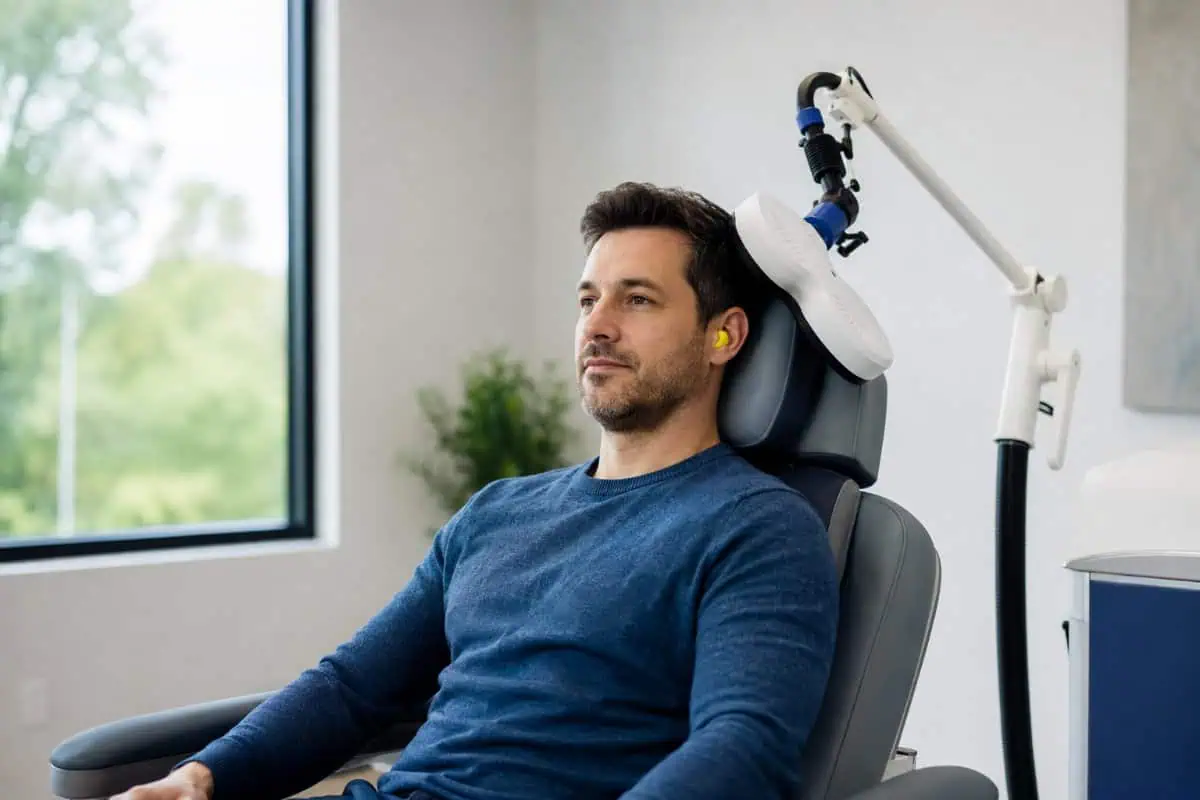
If you and your clinician decided to proceed, the practical shape is similar to a standard TMS course. Sessions are daily on weekdays, you sit upright and awake, there is no anaesthesia and no recovery time, and you drive yourself home afterwards. A course runs several weeks.
Side effects are the same ones documented for TMS generally: scalp discomfort at the stimulation site and headache are the common ones, and both usually settle within the first week or two. Seizure is a rare risk that screening is designed to identify in advance. Our guide to TMS side effects covers this in detail.
The part that is different is cost. Because this use is off-label, insurance will not cover TMS for ADHD. Coverage exists for cleared indications, which is a real distinction and one you should confirm directly with your plan rather than with a clinic’s billing estimate.
Questions worth asking any clinic that offers it
If a provider does offer TMS aimed at ADHD, the questions below will tell you quickly how carefully they are working.
- Which target and frequency do you use for attention symptoms, and what is that choice based on?
- How many sessions do you consider a full course, and what happens if there is no change?
- What outcome measure will you use to judge whether this is working, and when will we review it?
- Do you describe this use as off-label and investigational in writing?
- What is the total cost, and do you confirm in advance that insurance will not cover it?
A clinic that answers these directly, including the uncomfortable ones, is engaging with the evidence. A clinic that responds with success rates and testimonials is not. The willingness to say “we do not know yet” is the signal worth looking for.
What we tell families who ask
We prefer a slightly disappointing conversation to an inaccurate one. When a parent asks whether we can treat their child’s ADHD with TMS, the answer is that we cannot offer it as an established treatment for that, and we explain why. Frequently the more useful step is a careful reassessment, because attention complaints in a teenager often turn out to be entangled with sleep, anxiety, mood or a learning difference that nobody has looked at closely.
Where TMS does have a strong evidence base and a clearance behind it, we say so with equal directness. Depression in adolescents is one of those places. The position we hold is not that brain stimulation is unhelpful, but that it is helpful for specific things, and ADHD is not yet one of them.
Frequently Asked Questions
Is TMS FDA-approved for ADHD?
No. TMS devices are cleared for major depressive disorder, OCD, smoking cessation and anxious depression, and for adolescents aged 15 and over in the case of NeuroStar. There is no FDA clearance for ADHD, so any use aimed at ADHD is off-label and investigational.
Does TMS work for ADHD?
The evidence is early and mixed. Some studies report improvement in inattention measures and some find no difference from sham stimulation, and the protocols vary so much that pooling them is difficult. There is also no good data on how long any benefit lasts.
Will insurance cover TMS for ADHD?
No. Insurers cover TMS for cleared indications, and ADHD is not one of them. Confirm any coverage question with your own plan directly.
Should I stop my ADHD medication to try TMS?
That is not a decision to make on your own or on a clinic’s advice. Medication changes belong with the prescriber who knows your history, and in most cases there is no reason to stop an effective treatment.
Can a brain map diagnose ADHD?
No. A qEEG is an assessment input that describes patterns of electrical activity. It is interpreted alongside history and symptoms by a clinician, and it does not establish or rule out a diagnosis on its own.
Where That Leaves the Decision
TMS for ADHD sits in the awkward space between plausible and proven. The mechanism makes sense, the early research is not empty, and the honest description is still investigational. If you have exhausted the established options and want to talk through whether an off-label course is reasonable in your situation, we are glad to have that conversation and to tell you if we think the answer is no. Our team can be reached through our contact page.
This article is for general education and does not replace individual medical advice. Discuss your own history, medications and risk factors with a qualified provider before beginning treatment.