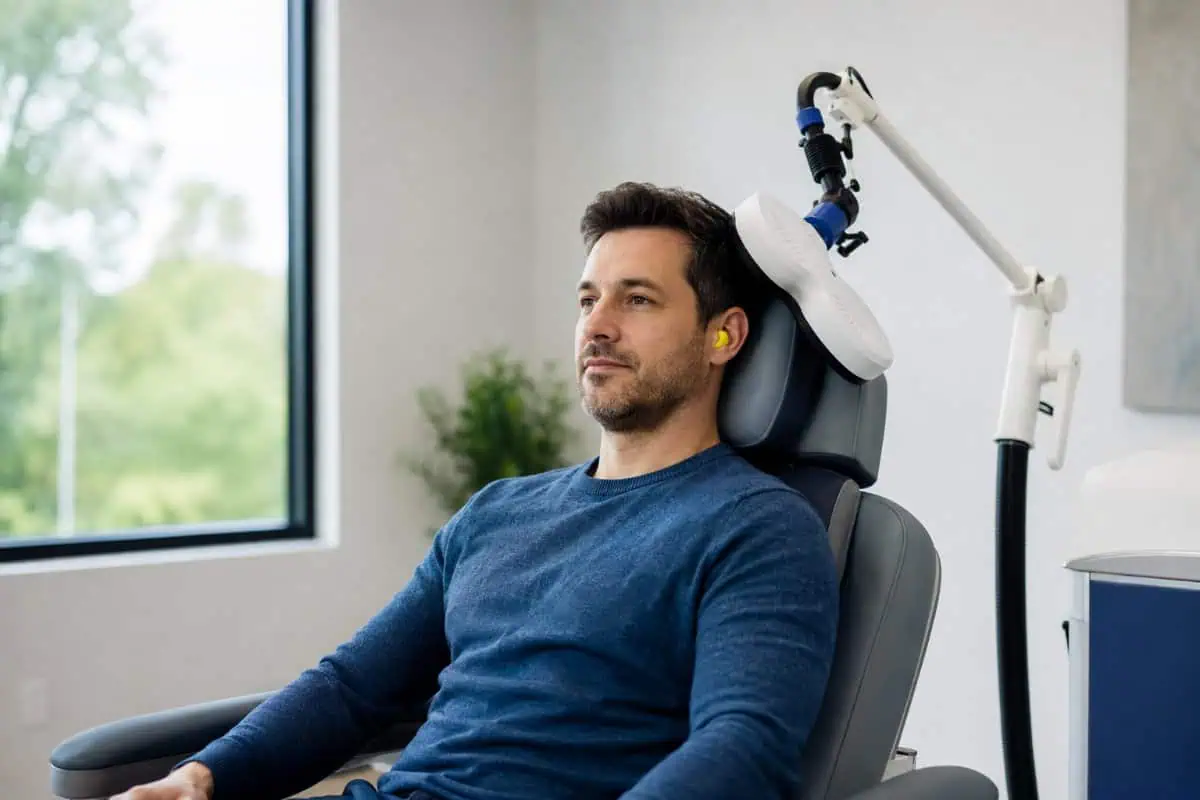
When people hear that a TMS session can take three minutes, the first reaction is usually suspicion. A standard session runs closer to forty. It is reasonable to assume that cutting it to a tenth means cutting the benefit too.
That assumption turns out not to hold, and the reason is a change in the rhythm of the pulses rather than a reduction in the treatment. Theta burst stimulation is a different way of delivering the same magnetic stimulation, and the trial evidence behind it is unusually good for a protocol this new.
What theta burst stimulation is
Standard repetitive TMS delivers pulses at a steady rate, commonly ten per second, in trains separated by rest intervals. Theta burst stimulation groups the pulses instead. It fires short bursts of three pulses at high frequency, and repeats those bursts about five times per second, a rhythm chosen because it resembles the brain’s own theta activity.
The clinically relevant version for depression is intermittent theta burst stimulation, usually shortened to iTBS. Intermittent means the bursts come in two-second runs with eight-second gaps, and that on-off pattern is what appears to produce an increase in cortical excitability rather than a decrease.
The practical consequence is time. Because the pulses are packed into bursts, the same therapeutic dose is delivered far faster than a conventional protocol can manage.
How much faster, precisely
An iTBS session takes about three minutes. A standard ten-hertz session takes 37.5 minutes. Those are the figures from the systems carrying the clearance, and the difference is not marketing rounding.
For a patient, that is the difference between a course that occupies a lunch break and one that requires rearranging a working day for six weeks. For a clinic, it is the difference between treating a handful of patients a day and treating many. Both of those matter for access, which is part of why the protocol spread quickly.
Why that particular rhythm
The name comes from theta activity, the roughly 4 to 8 Hz rhythm the brain produces in states of drowsiness and inward attention. Theta burst protocols were designed to imitate it because that timing appears unusually effective at producing lasting change in how readily neurons fire.
The underlying idea is synaptic plasticity: stimulation patterns that mirror the brain’s own timing seem to shift excitability more efficiently than a steady drumbeat of pulses at the same total dose. Theta burst was developed in animal work long before it reached psychiatry, and the pattern was carried across because of that efficiency rather than because it was convenient.
The clinical benefit followed from the laboratory finding rather than the other way round, which is a reassuring order for a treatment to arrive in.
What the FDA cleared, and when
The FDA cleared iTBS for major depressive disorder in April 2019, on the Magstim Horizon system. That clearance is specifically for depression. It is worth separating from two adjacent things it often gets confused with.
It is not the same as accelerated TMS, which refers to compressing a course by delivering several sessions per day rather than one. And it is not the same as SAINT, which was cleared in September 2022 and combines multiple daily sessions with an fMRI-selected target. Theta burst is the pulse pattern; those others are scheduling and targeting decisions built on top of it. We cover the compressed-schedule question separately in our piece on what accelerated TMS clearance means for patients.
The trial that made the case
The evidence that moved iTBS into routine use is the THREE-D trial, published in 2018. It was a randomised non-inferiority trial across three Canadian university hospitals, enrolling 414 adults with treatment-resistant depression. Participants received either conventional ten-hertz rTMS or iTBS.
The results were close to identical. On the 17-item Hamilton Depression Rating Scale, the ten-hertz group improved from 23.5 to 13.4, and the iTBS group improved from 23.6 to 13.4. The adjusted difference was 0.103, which supported the conclusion that iTBS was non-inferior to ten-hertz rTMS.
Non-inferior is the accurate word, and it is not the same as better. The trial was designed to show that the shorter protocol did not lose effectiveness, and that is what it showed. Anyone describing theta burst as more effective than standard TMS is going beyond what this trial established.
Dropout rates were similar, at 6 per cent for ten-hertz and 8 per cent for iTBS. Headache was the most common adverse event in both arms, affecting roughly 64 to 65 per cent of participants. One difference did reach statistical significance: iTBS was rated slightly more painful during treatment, 3.8 against 3.4 on a verbal scale.
So is it the better choice?
For most people starting a course for depression, iTBS is a sensible default, because it delivers comparable benefit in a fraction of the chair time and time is the main reason people abandon TMS courses partway through.
There are situations where a conventional protocol still makes sense. Some patients find the burst pattern less comfortable, and the pain difference in THREE-D was small but measurable. Some have responded well to a ten-hertz course previously, which is a reasonable argument for repeating what worked. And some treatment targets outside depression have their evidence base built on conventional protocols rather than theta burst, so the shorter option is not automatically transferable.
This is a decision that should be made on your clinical picture rather than on the clock, though we understand why the clock features heavily in how people think about it.
What a session involves
Little about the experience changes apart from the duration. You sit upright in a chair, awake, with a coil positioned against your scalp over the treatment target. There is no anaesthesia, no sedation and no recovery period, and you can drive yourself home. Most people describe a tapping sensation and a distinct clicking sound.
Because the session is short, the appointment is dominated by setup rather than treatment. Positioning and confirming the target takes longer than the stimulation itself. Our walkthrough of your first TMS session covers the visit in detail.
Side effects match TMS generally. Scalp discomfort and headache are the common ones and usually ease over the first week or two as people acclimatise. Seizure is a rare risk that pre-treatment screening exists to identify. Our guide to TMS side effects sets out the full picture.
What a compressed course looks like in practice
Because a session is three minutes, several can reasonably be delivered in a single day, and this is where theta burst and accelerated scheduling meet. A course that would conventionally run five days a week for six weeks can instead be delivered over a much shorter window.
The trade-off is not time for effectiveness but time for intensity of commitment. A compressed course means several hours at a clinic each day for a week or so, with gaps between sessions, rather than a short daily visit spread across a month and a half. For someone travelling to reach a clinic, that concentration is the entire appeal. For someone who works locally and cannot clear a full week, the conventional schedule is easier.
It is also worth saying that the evidence for compressed scheduling is younger than the evidence for theta burst itself. Non-inferiority was demonstrated for the pulse pattern in a course delivered on a standard daily schedule. Stacking sessions is a reasonable extension supported by its own growing literature, and it is not the same thing as the THREE-D result.
How it fits with a mapped approach
Choosing the pulse pattern is one decision. Choosing where to aim is another, and the two are independent. Conventional targeting uses scalp measurement from motor cortex; SAINT uses functional imaging; our own approach uses quantitative EEG to look at an individual’s activity pattern before deciding, which we describe in our guide to qEEG brain mapping.
A short protocol and a personalised target are compatible, and pairing them is increasingly the norm rather than a novelty.
Frequently Asked Questions
What is theta burst stimulation?
It is a form of TMS that delivers magnetic pulses in short high-frequency bursts repeated about five times per second, rather than at a steady rate. The intermittent version, iTBS, is the one cleared for depression.
How long does a theta burst session take?
About three minutes of stimulation, compared with 37.5 minutes for a standard ten-hertz session. The appointment itself is longer because positioning takes time.
Is theta burst as effective as standard TMS?
The THREE-D trial in 414 adults with treatment-resistant depression found iTBS non-inferior to ten-hertz rTMS, with both groups improving from about 23.5 to 13.4 on the Hamilton scale. Non-inferior means comparable, not superior.
Is theta burst stimulation FDA cleared?
Yes, for major depressive disorder, cleared in April 2019. That clearance does not extend to other conditions.
Is theta burst the same as accelerated TMS or SAINT?
No. Theta burst is the pulse pattern. Accelerated TMS means several sessions per day, and SAINT combines multiple daily sessions with an fMRI-selected target. They are often used together but they are separate choices.
Does theta burst hurt more?
Slightly, on average. In THREE-D, iTBS was rated 3.8 against 3.4 for ten-hertz on a verbal pain scale, a small but statistically significant difference. Most people acclimatise within the first week.
Deciding Between Protocols
Theta burst stimulation is the most consequential practical change in TMS delivery in the past decade, and it earned that position with a properly designed trial rather than enthusiasm. It is faster, it is comparably effective for depression, and for most people it removes the main obstacle to finishing a course. Whether it is the right protocol for you depends on your history and your treatment target, which is a conversation worth having before you book. Our team can be reached through our contact page.
This article is for general education and does not replace individual medical advice. Discuss your own history, medications and risk factors with a qualified provider before beginning treatment.