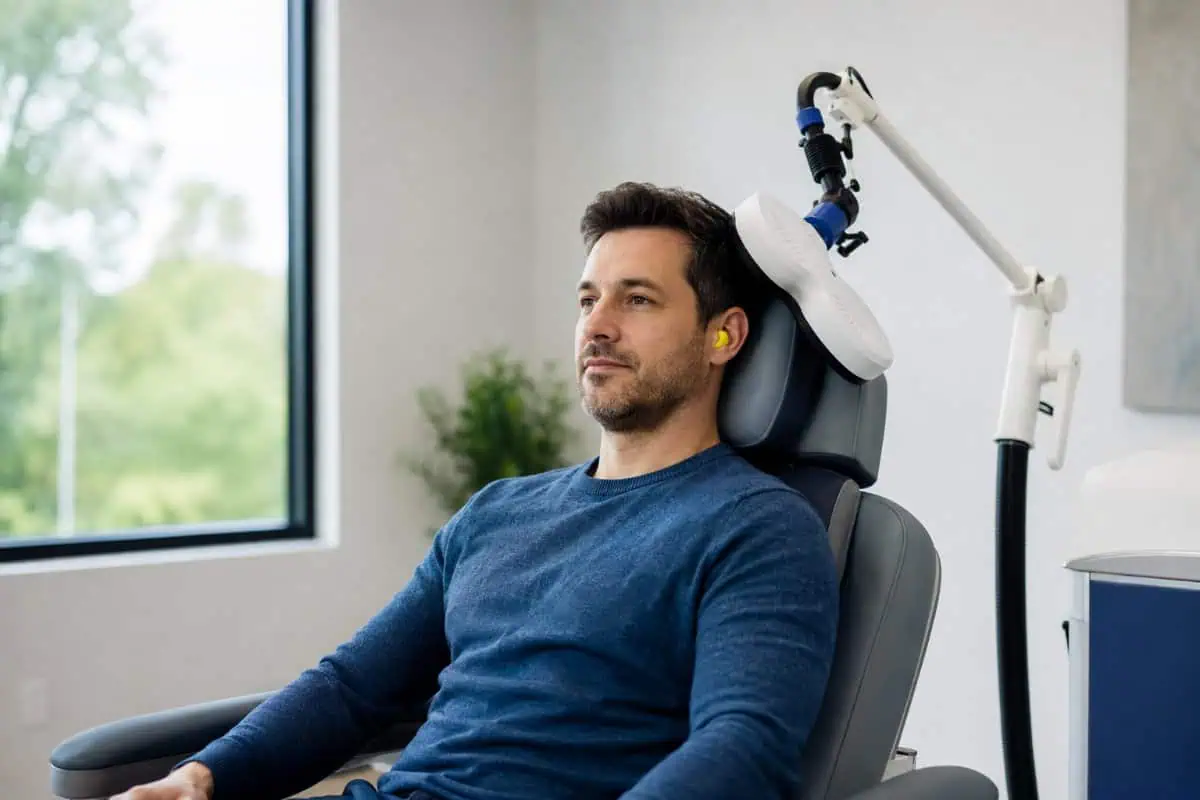
You walk into a restaurant and, before you notice the menu, you have already found the exits. You pick the seat with your back to the wall. A tray drops in the kitchen and your heart is pounding before you know why. For many people living with trauma, that constant scan is not a choice. It is hypervigilance.
Hypervigilance is a state of heightened alertness in which the brain keeps scanning for threats, even when the surroundings are safe. It is a symptom rather than a diagnosis. It is most closely tied to post-traumatic stress disorder (PTSD), where it is one of the formal arousal symptoms. It also appears with anxiety and panic disorders, childhood trauma, some medical conditions and certain substances. The good news is that it often eases when the underlying cause is treated.
This guide covers the hypervigilance meaning in plain terms, the symptoms to watch for, what drives it, why veterans feel it so strongly, and which treatments have the best evidence.
What hypervigilance means
At its core, hypervigilance is the brain’s threat-detection system set too high. Cleveland Clinic psychologist Susan Albers describes it as a basic human survival mechanism that has become overactive. In a dangerous setting, that scanning keeps you alive. The problem starts when it stays switched on at the grocery store, at work or at home.
Normal alertness rises and falls with the situation. You pay close attention while driving in a storm, then relax once you park. Hypervigilance does not switch off on cue. It tends to show up across many settings, it is tiring to sustain, and it often continues long after the original danger has passed.
Clinicians usually place hypervigilance under a broader heading called hyperarousal. Cleveland Clinic describes hyperarousal as a fight-or-flight state without a present danger. It includes jumpiness, a racing heart, trouble sleeping and irritability alongside the constant watchfulness.
Hypervigilance symptoms in daily life
Hypervigilance looks different from person to person. Some signs are obvious to others, while many are private habits of attention. The table below groups the common patterns Cleveland Clinic describes.
| Area | What it can look like |
|---|---|
| Surroundings | Sitting facing the door, checking locks repeatedly, scanning crowds and exits |
| Other people | Reading tone, faces and texts closely for signs of anger or rejection |
| Your body | Treating minor aches as signs of serious illness |
| Thinking | Jumping to the worst outcome, such as reading a missed call as bad news |
| Behavior | Avoiding driving, crowds, new places or social plans |
| Physical toll | Exhaustion, poor sleep, appetite and digestive changes |
| Mood | Irritability, outbursts, withdrawal, low mood |
Over time, the effort of staying on guard adds up for most people. People often describe feeling drained by evening without having done much. Concentration slips because so much attention goes to monitoring. Relationships can suffer when loved ones read the watchfulness as distrust.
What it feels like in the body
Because this watchfulness is part of the stress response, the body is involved too. Common physical signs of hyperarousal include an exaggerated startle, a racing or pounding heartbeat, fast breathing, sweating, muscle tension and trouble falling or staying asleep. These are real physical reactions, not imagined ones.
What causes hypervigilance
There is rarely a single cause. The most common drivers fall into four groups.
Trauma and PTSD
Trauma induced hypervigilance is the pattern most people know. In the DSM-5, PTSD includes a cluster called alterations in arousal and reactivity. A diagnosis requires at least three of six symptoms in that cluster. Hypervigilance and an exaggerated startle response are two of them, alongside irritability, reckless behavior, poor concentration and sleep problems. Symptoms must last more than a month.
PTSD is common. According to the VA National Center for PTSD, about 6% of U.S. adults will have PTSD at some point in their lives, compared with about 7% of veterans. Among veterans of the wars in Iraq and Afghanistan, the estimated lifetime rate is 29%.
Hypervigilance in anxiety
Anxiety and panic disorders also produce hypervigilance, though it often looks a little different. With trauma, the scanning tends to center on reminders of what happened. With generalized anxiety, it may spread to health, money, relationships or safety in general. With panic disorder, many people watch their own heartbeat and breathing closely for signs of an attack. Our anxiety and OCD page explains how these conditions are assessed.
Childhood trauma and complex trauma
Cleveland Clinic notes that childhood trauma is strongly linked to hypervigilance. A child who grew up reading a parent’s mood to stay safe may carry that skill into adult life. Complex PTSD, which can follow prolonged or repeated trauma, is another common source.
Medical conditions and substances
Not every case is psychological. Cleveland Clinic lists thyroid and adrenal disorders, fibromyalgia and neurodegenerative conditions such as dementia among possible causes. Caffeine, nicotine, alcohol and stimulant drugs such as cocaine can all drive hyperarousal, as can poor sleep. ADHD and autism can also come with heightened sensory alertness. This is why a good evaluation includes a medical history, not only a mental health screen.
Why veterans and service members feel it so strongly
Military training teaches people to scan, anticipate and react fast. In a combat zone, that kind of vigilance is useful and often lifesaving. The difficulty comes later, when the same reflexes fire in a parking lot, on the highway or at a child’s school event.
Many veterans describe the adjustment home as learning to stand down a system that was built on purpose. That is not weakness or a failure to adapt. It is a trained response running in a setting where it no longer fits. Our article on the transition from military life looks at the wider challenges of that shift. First responders, such as police, firefighters and paramedics, often describe a similar pattern.
Families notice it too. Partners and children may feel they have to tiptoe, or may not understand why a loud noise ends an outing. Talking openly about hypervigilance as a symptom, rather than a mood or a choice, often helps a household cope.
Social hypervigilance
Social hypervigilance is a lay term for scanning people rather than places. It means watching faces, tone of voice and messages for any sign of disapproval, anger or rejection. It is not a formal diagnosis, but it often appears with social anxiety, childhood trauma or relationships that once felt unsafe.
People with this pattern may over-apologize, rehearse conversations or replay them for hours afterward. The constant reading of others can be draining and can make close relationships feel more fragile than they are.
How clinicians screen for hypervigilance
There is no standalone test for this symptom, and an online quiz cannot diagnose it. What clinicians use are screening tools for the conditions behind it.
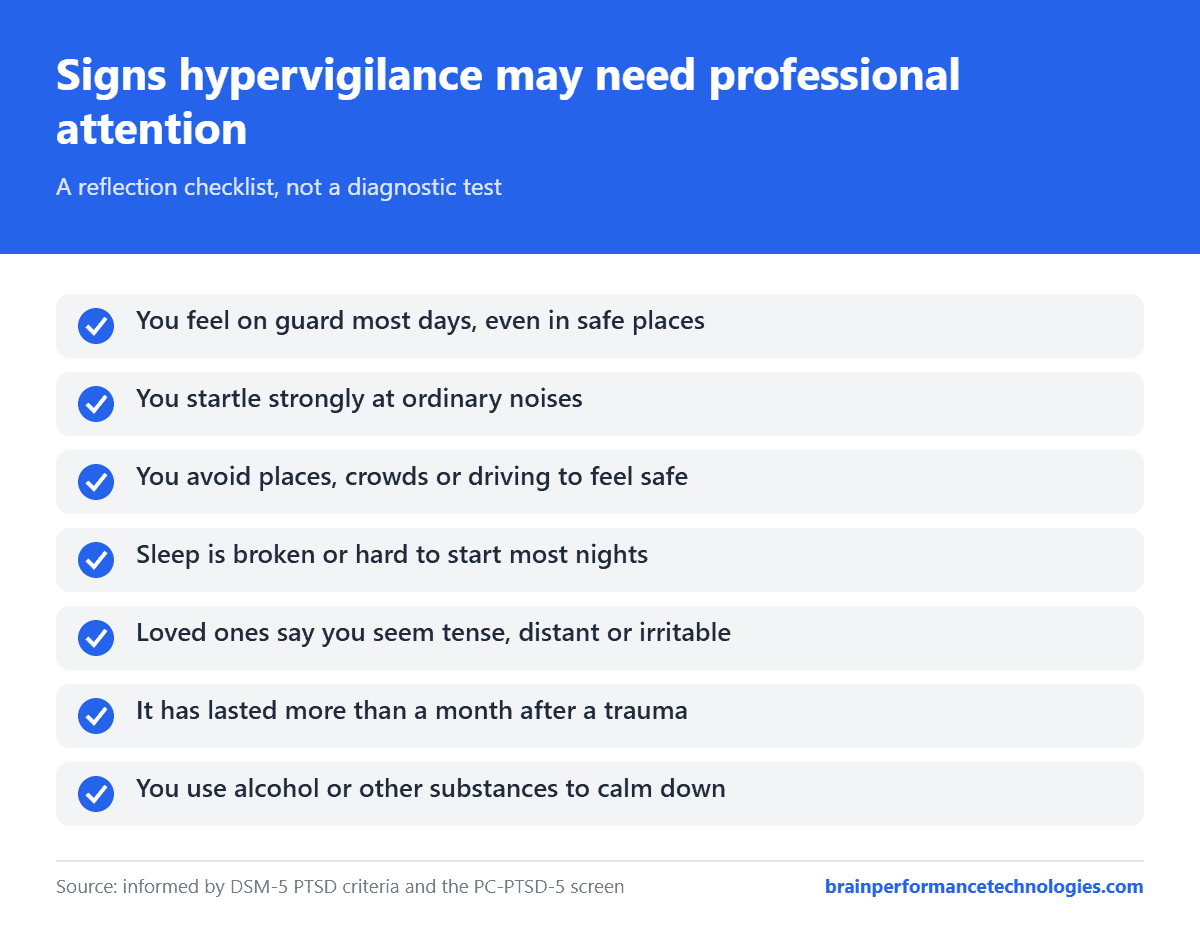
One example is the Primary Care PTSD Screen for DSM-5 (PC-PTSD-5). One of its five questions asks whether you have “been constantly on guard, watchful, or easily startled” in the past month. According to the University of Washington’s guide to the screen, a “yes” to any three of the five items counts as a positive screen. A positive screen means further assessment is needed, not that PTSD is confirmed.
The checklist below is for reflection only. If several items fit, it may be time to talk with a clinician.
How to stop hypervigilance, or at least turn it down
You cannot reason your way out of hypervigilance, because it runs below conscious choice. The realistic goal is to lower the baseline over time and recover faster when it spikes. These steps are commonly recommended by clinicians, and they work best alongside treatment rather than in place of it.
- Ground yourself in the present. Name five things you can see, four you can hear and three you can touch.
- Slow your breathing. A longer exhale than inhale helps signal safety to the body.
- Separate feelings from facts. Ask, “What is the evidence of danger right now?”
- Cut back on caffeine and alcohol, which can both raise anxiety.
- Keep regular sleep and wake times, since poor sleep lowers your threshold for alarm.
- Practice mindfulness on calm days, so the skill is there on hard ones.
- Reduce avoidance gradually, ideally with a therapist, because avoidance tends to keep the alarm set high.
Treatment for hypervigilance
Treatment focuses on the condition driving the symptom. For trauma-related hypervigilance, the evidence is strongest for specific psychotherapies.
Trauma-focused psychotherapy
The 2023 VA/DoD clinical practice guideline for PTSD recommends three trauma-focused therapies: prolonged exposure, cognitive processing therapy and eye movement desensitization and reprocessing (EMDR). The guideline favors these manualized psychotherapies over medication as first-line care. Each, in a different way, helps people process the trauma so that reminders gradually lose their power.
Medication
The same guideline recommends paroxetine, sertraline or venlafaxine for PTSD when medication is used. It advises against benzodiazepines and against cannabis or cannabis-derived products for PTSD. When hypervigilance comes from an anxiety disorder, thyroid problem or other condition, treatment for that condition takes priority. A prescriber should guide any medication decision.
Where TMS and MeRT fit
Transcranial magnetic stimulation is FDA-cleared for major depression, OCD, smoking cessation and anxious depression. It is not FDA-cleared for PTSD. The 2023 VA/DoD guideline found insufficient evidence to recommend for or against repetitive TMS for PTSD.
A 2020 VA evidence brief reviewed 10 randomized trials of TMS for PTSD. It rated the evidence as low strength, and only four of those trials found more improvement with TMS than with sham. That is a reason for caution, not for dismissal. Research is ongoing, and TMS may be relevant when depression, which often travels with PTSD, is part of the picture. Our page on TMS for PTSD covers this research in more depth.
MeRT is an individualized, off-label approach that uses a qEEG brain map to adjust stimulation settings. Its evidence base for PTSD is still early. You can read how we describe it, and its limits, in our article on MeRT for PTSD. Any brain-based treatment should complement, not replace, evidence-based therapy.
When to get help right away
On its own, this symptom is not an emergency. It becomes urgent when it comes with thoughts of suicide, self-harm or harming others, or when someone feels they cannot stay safe.
If you or someone you love is in crisis, call or text 988 to reach the 988 Suicide and Crisis Lifeline. Veterans and service members, and the people who care about them, can reach the Veterans Crisis Line by dialing 988 and pressing 1. Both are free and available 24 hours a day. If there is immediate danger, call 911.
For non-urgent support, a good next step is a full evaluation. Our PTSD conditions page explains how we assess trauma-related symptoms, and you can reach our team here.
Frequently Asked Questions
What is hypervigilance a sign of?
Hypervigilance is most often a sign of PTSD or another trauma-related condition. It also appears with anxiety and panic disorders, after childhood trauma, and occasionally with medical issues such as thyroid disorders or with heavy caffeine or stimulant use.
Is hypervigilance always caused by PTSD?
No. PTSD is the best-known cause, and hypervigilance is one of its formal symptoms. However, anxiety disorders, complex trauma, sleep loss, some medical conditions and substances can all produce it. A clinician can help sort out which applies.
Can hypervigilance go away?
For many people it eases substantially with treatment of the underlying condition, especially trauma-focused therapy for PTSD. It may not vanish overnight, but most people can learn to lower the baseline and recover faster from spikes.
What is social hypervigilance?
Social hypervigilance describes closely monitoring other people’s faces, tone and messages for signs of disapproval or anger. It is not a formal diagnosis. It often appears with social anxiety or a history of relationships that felt unsafe.
Is there a test for hypervigilance?
There is no test for hypervigilance itself. Clinicians use screening tools such as the PC-PTSD-5, which includes a question about feeling constantly on guard, followed by a full assessment when the screen is positive.
Can TMS help with hypervigilance?
TMS is not FDA-cleared for PTSD, and current VA/DoD guidance finds the evidence insufficient to recommend for or against it. Studies are small and mixed. TMS is cleared for depression, so it may help if depression is part of the picture.
Lowering the Alarm, One Step at a Time
Hypervigilance is a survival system doing its job too well. It is common after trauma, it is common in anxiety, and it is not a personal failing. Understanding where it comes from is the first step toward turning it down.
The most reliable path combines a careful evaluation, treatment that targets the real cause, and practical skills you can use day to day. If constant alertness is shaping your life or your family’s, support is available, and progress is realistic.
This article is for general education and does not replace individual medical advice. Discuss your own history, medications and risk factors with a qualified provider before beginning treatment.