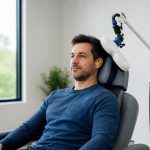
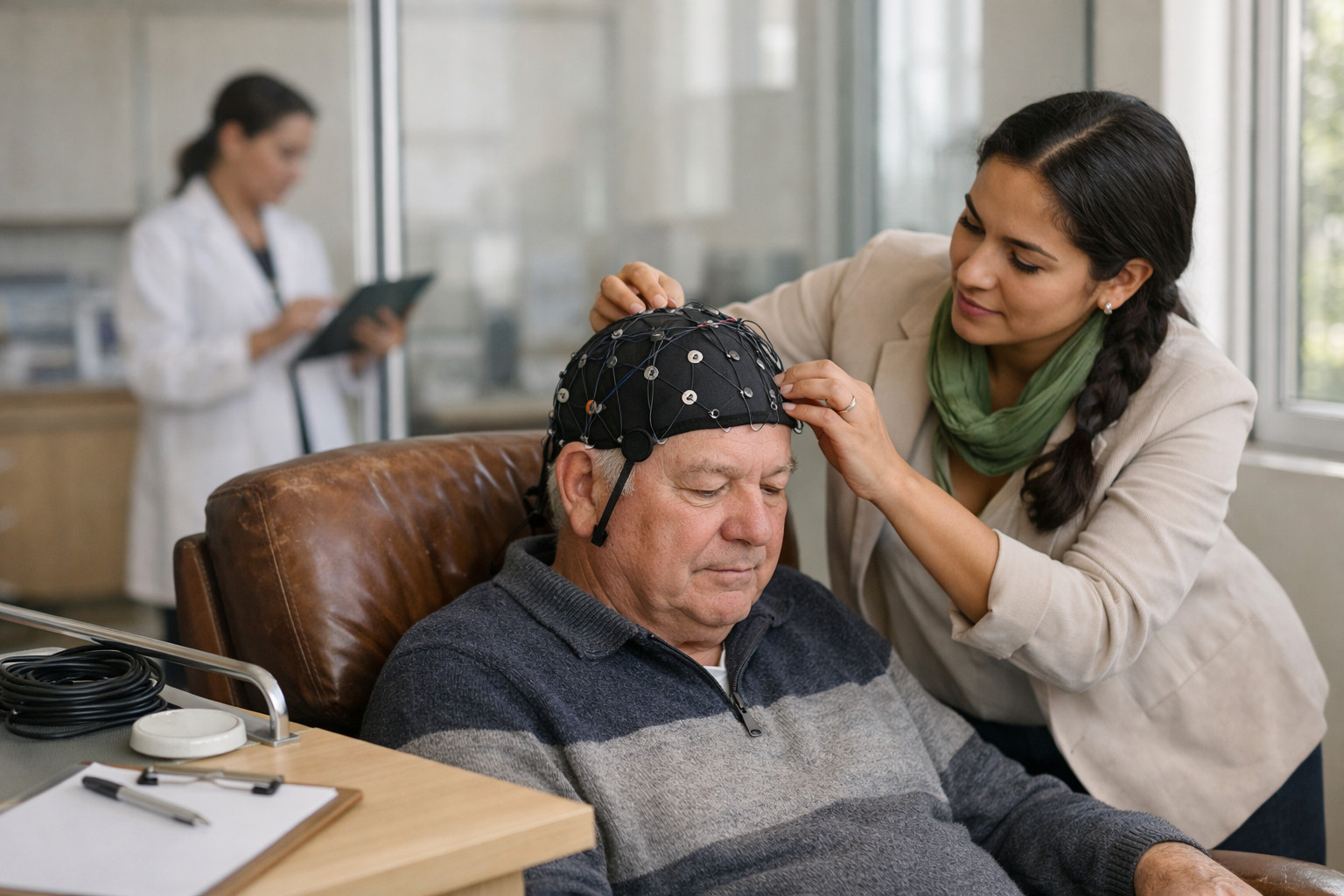
In recent years the use of technology and brain stimulation has become more recognized in the treatment plan for PTSD. MeRT (Magnetic eResonance Therapy) is a form of brain stimulation that helps the parts of the brain that are not communicating as they should.
A brain that is functioning optimally can lead to dramatic improvements and learning in all the traditional forms of therapy for PTSD. There are many ways to research MeRT and its benefits regarding PTSD, as well as other conditions it can be used for. Here are a few examples of research on PTSD:
1. MeRT Research for PTSD
1.1. Wave Neuroscience developed an ongoing clinical trial evaluating the safety and efficacy of Magnetic e-Resonance Therapy (MeRT) treatment in Post-Traumatic Stress Disorder (PTSD). MeRT is a form of brain stimulation that uses low-intensity magnetic fields to stimulate specific areas of the brain to address various neurological and neuropsychiatric conditions like PTSD. It places electromagnetic coils near the scalp to deliver magnetic pulses to help regulate neural activity in targeted brain regions.
MeRT’s main goal is to improve brain functioning and alleviate symptoms associated with the condition. In this clinical trial, Wave Neuroscience has collected 152 participants, some participants will receive the Active MeRT Treatment, while others receive the Sham MeRT Treatment.
The Active MeRT Treatment consists of a personalized MeRT treatment that is tailored to each participant. Those receiving the Sham MeRT Treatment will be perceived to be getting the treatment, however, the rTMS coil will not emit the magnetic stimulation. This clinical trial will help us to better understand the efficacy and safety of MeRT. You can follow WaveNeuro’s clinical trial here.
1.2. Taghva and Silvetz et. Al., (2015) conducted a study that worked to “determine if magnetic brain stimulation can induce normalization of EEG abnormalities and improve clinical symptoms in PTSD in a preliminary, open-label evaluation” (Taghva and Silvetz et. Al., (2015)). Their objective was also to determine whether MeRT will improve clinical phenotype and EEG alpha power in Post Traumatic Stress Disorder (PTSD). EEG alpha refers to the specific frequency range of brainwave activity that is measured during the EEG. They reviewed data on 21 veterans who had been previously treated for PTSD.
These participants were subjected to MeRT for two weeks with different frequencies depending on the patient’s EEG frequencies. After the two-week sessions, Taghva and Silvetz et. Al., (2015) found that there was a notable improvement in clinical symptoms in all remaining 16 patients and only 11 patients had increases in global EEG alpha.
In conclusion, the study suggested that non-invasive neuromodulation MeRT may lead to improvement in symptoms, as well as a normalization of EEG frequencies in PTSD.
Taghva, A., Silvetz, R., Ring. A., Kim, K., Murphy, K., Liu, C., Jin, Y. (2015). Magnetic Resonance Therapy Improves Clinical Phenotype and EEG Alpha Power in Posttraumatic Stress Disorder. Trauma Monthly, 20(4), e27360.
2. Psychotherapy Research for PTSD
2.1. Eye Movement Desensitization and Reprocessing (EMDR) is a common treatment for individuals with PTSD. EMDR integrates elements of exposure therapy with bilateral stimulation techniques where the individual recalls their traumatic event while simultaneously focusing on external stimuli.
It facilitates the processing of traumatic memories by integrating them into a broader cognitive-emotional framework reducing emotional intensity and distress. Researchers Wippich and Howatson et. al., (2023) conducted a study regarding the efficacy of EMDR in treating posttraumatic stress (PTS), anxiety, and depression.
They used a sample consisting of two hundred and sixty-eight adults living in conflict-affected areas in Lebanon with low socioeconomic status. They all received EMDR therapy, and their measurements of PTS, anxiety, and depression were taken at three different periods of the study. Those with a clinical concern of PTSD, with probable PTSD diagnosis, and with severe PTSD who received EMDR treatment demonstrated a decrease in PTS symptoms. The largest decrease was in those with severe PTSD.
The research supported the use of EMDR for the treatment of PTS, depression, and anxiety. Wippich and Howatson et. Al., (2023) found that the course of EMDR treatment should include an average number of 7.5 sessions per individual. Since it requires less than the average duration of suggested treatment sessions (8-12) and it does not require the completion of homework tasks, they also demonstrated that EMDR is considered the most cost-effective treatment for treating PTSD in adults.
Whippich, A., Howaston, G., Allen-Baker, G., Farrell, D., Kiernan, M. (2023). Eye movement desensitization reprocessing as a treatment for PTSD in conflict-affected areas. Psychological Trauma: Theory, Research, Practice, and Policy, https://doi.org/10.1037/tra0001430
3. FAQs
Q: Where can I find more research on MeRT?
A: You can find more research on MeRT and PTSD, as well as other conditions, on our website. More research can be found on WaveNeuro’s research site, including the clinical trial above.